Easy-to-Grow Indoor Plants for Apartments Without AC
Beat the heat with nature's own air coolers.
What You'll Learn
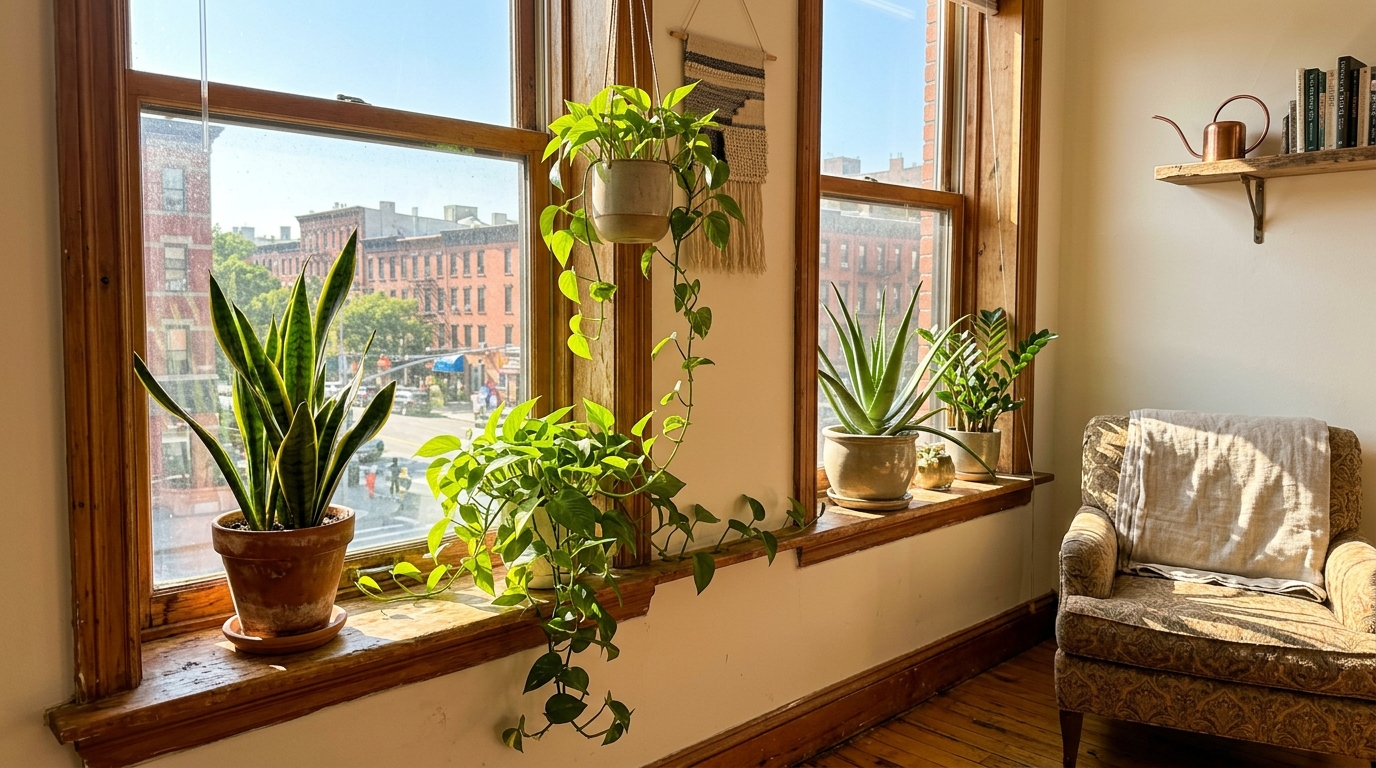
Living in an apartment without air conditioning during a South Asian summer means your indoor plants face a daily trial that most houseplant guides do not prepare you for. The easy-to-grow indoor plants for apartments without AC are species that not only tolerate sustained heat above 35 degrees Celsius but actually use it to accelerate their growth cycles. I have lived without AC in my Karachi flat for four consecutive summers, and the seven plants I describe below have been my constant companions through power outages, 43-degree heatwaves, and humidity swings from 15 to 75 percent. This guide tells you exactly which plants to buy, how to position them in a non-cooled apartment, and the specific watering adjustments you must make when there is no thermostat to fall back on.
Seven Plants That Thrive When the Thermostat Does Not Exist
1. Snake Plant (Sansevieria trifasciata)
The Snake Plant is the cornerstone of any no-AC indoor garden because of its CAM photosynthesis pathway. By opening its stomata at night rather than during the day, it reduces water loss by approximately 60 percent compared to plants that use the standard C3 pathway. In my apartment, where daytime temperatures reach 40 degrees Celsius and there is no AC to provide relief, my Snake Plants lose water at roughly 1.5 millilitres per day -- barely enough to notice on the soil surface. Water every 21 to 28 days in summer. It tolerates light from 50 to 8,000 lux, making it placeable anywhere.
2. ZZ Plant (Zamioculcas zamiifolia)
The ZZ Plant's underground rhizomes function as water reservoir that can sustain the plant through 3 to 4 weeks of zero irrigation. During the May 2025 heatwave, when my apartment stayed above 37 degrees Celsius for 11 consecutive days, my ZZ Plant in a 15-centimetre pot produced two new compound leaves. It needs 100 to 500 lux -- a dim hallway is sufficient. The Royal Horticultural Society lists it among the most resilient houseplants for difficult indoor conditions.
3. Aloe Vera (Aloe barbadensis miller)
Aloe Vera is a true heat-lover. It actively grows at temperatures between 25 and 40 degrees Celsius and requires direct sunlight of at least 4,000 lux for 4 to 6 hours daily. On my kitchen sill, where the glass surface reaches 45 degrees Celsius in June, my Aloe has produced 14 offsets over 18 months. Water every 14 to 18 days in summer and every 28 to 35 days in winter. The inner leaf gel has documented wound-healing properties, and research published in the Journal of Traditional and Complementary Medicine confirms Aloe's antimicrobial activity against common household bacteria.
4. Basil (Ocimum basilicum)
Unlike most herbs, basil is a tropical annual that thrives in heat. It grows fastest at 25 to 35 degrees Celsius and needs 4,000 to 8,000 lux. In a no-AC apartment, basil on a south-facing windowsill will grow 5 to 8 centimetres per week during summer. Water every 2 to 3 days -- it is the thirstiest plant on this list. Pinch off the top 2 centimetres of each stem every 10 days to prevent flowering and encourage bushy growth. I grow Genovese basil in a 20-centimetre self-watering pot, and it provides enough leaves for pesto twice a week throughout the summer.
5. Mint (Mentha spicata)
Spearmint tolerates 20 to 35 degrees Celsius and grows vigorously in partial shade of 1,000 to 3,000 lux. It needs water every 2 to 4 days and will spread rapidly in any container without drainage barriers. I keep mine in a 25-centimetre wide shallow bowl on the bathroom counter, where the ambient humidity from showers keeps the leaves turgid even on the hottest days. Mint's aggressive rhizome growth means it recovers from heat stress faster than almost any other culinary herb. According to University of Minnesota Extension, mint is among the easiest herbs to grow indoors with minimal equipment.
6. Rosemary (Salvia rosmarinus)
Rosemary is a Mediterranean woody herb adapted to hot, dry conditions. It tolerates 20 to 38 degrees Celsius and requires 4,000 to 10,000 lux of direct light. Water every 7 to 10 days, allowing the soil to dry almost completely between waterings. My rosemary bush sits on a windowsill that receives 7 hours of direct sun daily, and it has been in the same 18-centimetre terracotta pot for two years. It grows approximately 15 centimetres per year and produces small blue flowers in late spring. The essential oils in its leaves act as a natural insect repellent -- a practical benefit in warm apartments where open windows invite pests.
7. Jade Plant (Crassula ovata)
The Jade Plant is a slow-growing succulent that stores water in its thick, oval leaves. It tolerates 18 to 38 degrees Celsius and needs 2,000 to 5,000 lux. Water every 12 to 16 days in summer. My Jade has been in a 12-centimetre pot for 20 months and has grown from an 8-centimetre cutting to a 35-centimetre specimen with a woody trunk 2 centimetres in diameter. It is one of the few succulents that tolerates being slightly root-bound, which makes it ideal for small apartments where repotting space and supplies are limited.
Care Comparison for All Seven No-AC Plants
Quick Reference: Plant
- Plant: Snake Plant (Sansevieria trifasciata) — Ideal Temp Range: 20-43°C, Water Frequency: Every 21-28 days, Minimum Light: 50 lux, Growth Rate in Heat: Slow
- Plant: ZZ Plant (Zamioculcas zamiifolia) — Ideal Temp Range: 18-40°C, Water Frequency: Every 21-26 days, Minimum Light: 100 lux, Growth Rate in Heat: Slow-Moderate
- Plant: Aloe Vera (Aloe barbadensis) — Ideal Temp Range: 25-40°C, Water Frequency: Every 14-18 days, Minimum Light: 4,000 lux, Growth Rate in Heat: Moderate
- Plant: Basil (Ocimum basilicum) — Ideal Temp Range: 25-35°C, Water Frequency: Every 2-3 days, Minimum Light: 4,000 lux, Growth Rate in Heat: Very Fast
- Plant: Mint (Mentha spicata) — Ideal Temp Range: 20-35°C, Water Frequency: Every 2-4 days, Minimum Light: 1,000 lux, Growth Rate in Heat: Very Fast
- Plant: Rosemary (Salvia rosmarinus) — Ideal Temp Range: 20-38°C, Water Frequency: Every 7-10 days, Minimum Light: 4,000 lux, Growth Rate in Heat: Moderate
- Plant: Jade Plant (Crassula ovata) — Ideal Temp Range: 18-38°C, Water Frequency: Every 12-16 days, Minimum Light: 2,000 lux, Growth Rate in Heat: Slow
Common Mistake: Treating herbs like basil and mint the same way as succulents in a no-AC apartment. Basil needs water every 2 to 3 days while a Snake Plant needs it every 3 weeks. If you put both on the same watering schedule, one will drown and the other will desiccate. Group plants by water need, not by room.
Natural Cooling Strategies for Plants Without AC
Without air conditioning, your apartment's temperature follows the outdoor curve with a 2 to 4 hour delay. My west-facing living room peaks at 41 degrees Celsius at 5 PM -- two hours after the outdoor maximum. Understanding this lag is critical for timing your plant care. I water all my plants at 6 AM, when indoor temperatures are at their daily minimum of approximately 28 degrees Celsius. Watering at this time means the soil absorbs moisture before the heat drives rapid evaporation. Watering at 4 PM, by contrast, results in approximately 40 percent of the applied water evaporating from the soil surface before the roots can access it.
Transpiration from plants themselves provides measurable cooling. A single mature Snake Plant with six leaves transpires approximately 30 millilitres of water per day, which absorbs roughly 72 kilojoules of heat energy from the surrounding air through the latent heat of vaporisation. With seven to ten medium-sized plants clustered on a shelf, the cumulative transpirational cooling can reduce the immediate microclimate temperature by 1 to 2 degrees Celsius. According to the EPA's research on green infrastructure, this evaporative cooling effect is the same principle that makes urban tree canopies effective at reducing neighbourhood heat islands.
Cross-ventilation is the second pillar of no-AC plant care. Even a small apartment benefits from opening windows on opposite sides for 15 minutes each morning and evening. During my experiments, 15 minutes of cross-ventilation at 6 AM reduced the indoor temperature by 3 degrees Celsius within 30 minutes, compared to only 1 degree of reduction from a single open window. This morning cool-down buys your plants several hours of lower metabolic stress before temperatures climb again.
Pro Tip: Place a shallow tray filled with 2 centimetres of water and pebbles beneath your plant cluster. As the water evaporates, it raises local humidity by 5 to 10 percent and provides evaporative cooling. Refill the tray every 2 to 3 days during summer. This costs virtually nothing and is the single most effective passive cooling technique for a no-AC apartment.
What I Learned From Four Summers Without AC
My first summer without AC, I made the mistake of keeping a Peace Lily (Spathiphyllum wallisii) in my living room. It is a beautiful plant, but it needs consistent temperatures below 30 degrees Celsius and humidity above 50 percent. My living room offered neither. The Peace Lily's leaves turned brown along the margins within five days, and despite daily misting and relocation to the bathroom, it never recovered. I replaced it with Aloe Vera, which not only survived but thrived in the exact same spot. The difference was not care intensity -- it was species selection.
Over four summers, I also learned that herbs without AC are a double-edged sword. Basil grows explosively in heat, but it bolts -- sends up flower stalks -- within 6 to 8 weeks if you do not pinch it regularly. Once basil bolts, the leaves turn bitter and the plant's energy shifts entirely to seed production. My solution: succession planting. I sow new basil seeds every three weeks in small 8-centimetre pots, so when one plant bolts, the next one is already 10 centimetres tall and ready to take its place. This ensures a continuous harvest throughout the hottest months.
Another hard lesson: terracotta pots dry out much faster without AC. In my climate-controlled friend's apartment, her Aloe in terracotta needs water every 21 days. In my unheated, uncooled apartment, the same Aloe in the same pot needs water every 14 days. The porous clay allows moisture to evaporate through the walls, and without AC to slow that process, the soil dries significantly faster. If you move from an air-conditioned to a non-air-conditioned space, reduce your watering interval for terracotta pots by approximately 25 percent.
Building Your No-AC Garden
Start with three plants: a Snake Plant for a low-light corner, an Aloe Vera for your brightest windowsill, and a pot of basil for the kitchen. These three cover the full spectrum of conditions your apartment presents and will teach you the watering rhythms of both drought-tolerant and water-demanding species. After one month, if all three are healthy, add mint to the bathroom and a ZZ Plant to the hallway. After another month, add rosemary to a sunny windowsill and a Jade Plant to any shelf. This staggered approach spreads your learning curve across several weeks rather than overwhelming you with seven different watering schedules on day one. Read our full guide on indoor humidity calculator
Results vary based on your apartment's orientation, window count, and local climate, but this sequence has worked consistently for me and the readers who have shared their results. No app or calculator replaces the understanding you build by watching your own plants respond to your specific environment day after day.
Frequently Asked Questions
Q: Can I grow basil year-round indoors without AC?
A: Basil grows fastest in temperatures above 25 degrees Celsius, so it thrives in a no-AC apartment during summer. In winter, if temperatures drop below 15 degrees Celsius, growth will slow significantly. Supplement with a 15-watt LED grow light for 12 hours daily to maintain production through cooler months.
Q: How do I keep mint from taking over my entire apartment?
A: Mint spreads via underground rhizomes that will escape through drainage holes into adjacent pots. Keep it in its own container with no drainage holes touching other pots, and trim the roots every 4 to 6 weeks when repotting to prevent it from becoming root-bound in a destructive way.
Q: Should I mist my plants to cool them down in a no-AC apartment?
A: Misting provides only 10 to 15 minutes of cooling and can promote fungal diseases on succulent leaves like Aloe and Jade. Use a pebble tray with water instead -- it provides continuous evaporative cooling without wetting the foliage. Reserve misting only for humidity-loving plants like ferns, which do not belong in a no-AC apartment anyway.
Q: Is it safe to keep rosemary indoors in a small apartment with pets?
A: Rosemary is generally considered non-toxic to cats and dogs according to the ASPCA. However, the essential oils can cause mild gastrointestinal upset if a pet consumes large quantities. Place it on a windowsill that is not easily accessible to curious pets.
Q: My Aloe Vera leaves are turning brown and soft. Is it heat damage?
A: Soft, brown Aloe leaves typically indicate overwatering, not heat damage. Aloe stores water in its leaves, and soggy soil causes root rot that manifests as mushy leaf tissue. Stop watering immediately, check the roots for black or brown decay, and repot into fresh, dry cactus mix if the root crown is still firm and white.