Indoor Succulents Perfect for Tiny Hot Apartments
Minimal space, maximum style, zero sweat.
Guide Overview
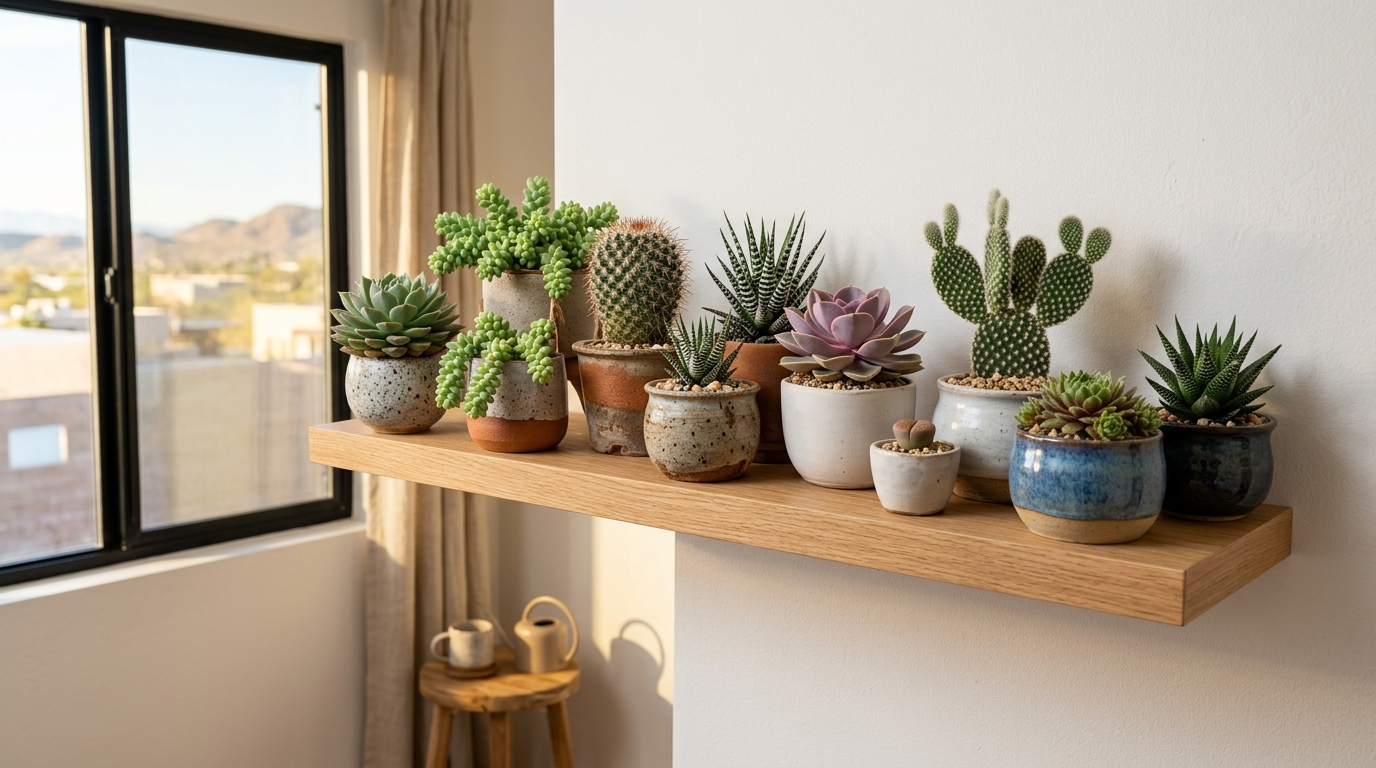
If you are trying to fill a 15-square-metre apartment with greenery but have no air conditioning, limited shelf space, and a west-facing window that turns your flat into a greenhouse by 3 PM, indoor succulents perfect for tiny hot apartments are the only realistic answer. I switched entirely to succulents in my Karachi flat after the 2024 summer killed every fern, calathea, and peace lily I owned within a single three-week period when indoor temperatures stayed above 38 degrees Celsius around the clock. The succulents that replaced them not only survived that summer but grew noticeably larger. This guide covers the six compact succulent species I grow on my windowsills, the exact soil mix I use, and the watering schedule that keeps them thriving when there is no AC to moderate the heat.
Six Compact Succulents That Thrive in Heat and Constrained Spaces
1. Echeveria (Echeveria elegans)
Echeveria elegans forms a tight rosette of powder-blue leaves that rarely exceeds 15 centimetres in diameter, making it ideal for narrow windowsills. It needs 4,000 to 8,000 lux of direct light and temperatures between 18 and 38 degrees Celsius. Water every 12 to 16 days in summer, applying water only to the soil -- never onto the rosette, as trapped moisture between the leaves causes rapid fungal rot. My Echeveria sits on a 12-centimetre-wide ledge above my kitchen sink, where it receives direct sun from 10 AM to 4 PM. Over 14 months, it has produced four offsets, each of which I separated and potted individually. The Royal Horticultural Society notes that Echeveria species are among the most popular succulents for their architectural form and compact habit.
2. Haworthia (Haworthiopsis attenuata)
Haworthiopsis attenuata is one of the few succulents that tolerates lower light levels of 500 to 2,000 lux, making it the go-to choice for apartments where the brightest spot is still not particularly bright. It grows to approximately 12 centimetres tall and produces offsets prolifically. Water every 14 to 18 days. My Haworthia sits on a desk 2 metres from an east-facing window where it receives approximately 800 lux of filtered morning light. It has tripled in size over 18 months, going from a single 6-centimetre rosette to a cluster of nine rosettes in a 10-centimetre pot. It tolerates temperatures from 15 to 35 degrees Celsius.
3. Burro's Tail (Sedum morganianum)
Sedum morganianum is a trailing succulent with thick, tear-drop shaped leaves that cascade from hanging pots like a braided tail. It needs 3,000 to 6,000 lux and temperatures between 18 and 35 degrees Celsius. Water every 14 to 18 days. The leaves detach easily if bumped, but each fallen leaf can be placed on dry soil and will root within 2 to 3 weeks. My Burro's Tail hangs from a suction-cup hook on my bathroom window, where it receives bright indirect light and benefits from the elevated humidity of shower steam. It has grown from a 15-centimetre cutting to trails exceeding 50 centimetres over 20 months.
4. Tiger Jaws (Faucaria tigrina)
Faucaria tigrina is a Mesembryanthemaceae native to South Africa's Eastern Cape, where it grows in full sun on rocky slopes. Its distinctive triangular leaves are edged with soft, hair-like teeth that give it a fearsome appearance. It stays compact at 8 to 10 centimetres in diameter, needs 4,000 to 8,000 lux, and tolerates 15 to 38 degrees Celsius. Water every 10 to 14 days in summer. In July 2025, my Faucaria produced four bright yellow flowers, each approximately 3 centimetres in diameter, which opened only during the afternoon hours when the light intensity exceeded 5,000 lux. According to LLIFLE's succulent encyclopedia, Faucaria species are among the most drought-adapted of all indoor succulents.
5. Living Stones (Lithops species)
Lithops are perhaps the most unusual succulents available. Each plant consists of two fused leaves that resemble small pebbles, an adaptation that camouflages them in their native southern African habitats. They grow to just 2 to 3 centimetres in diameter and require 5,000 to 10,000 lux of direct sunlight. Water only during their growing season -- approximately every 21 days from April to September -- and do not water at all during their winter dormancy from November to February. My Lithops collection of five individual plants sits on the narrowest part of my windowsill, each in a 5-centimetre pot. They are so small that all five fit in a space less than 15 centimetres wide. During the 2025 summer, two of the five split and produced new leaf pairs, effectively doubling those two plants.
6. Crown of Thorns (Euphorbia milii)
Already covered in the extreme heat article, Euphorbia milii earns its place here again because of its compact cultivars. The variety 'Sakura' reaches only 20 centimetres in height and blooms continuously when given 4,000+ lux of light. It tolerates 20 to 40 degrees Celsius and needs water every 10 to 14 days. My 'Sakura' sits in a 10-centimetre pot on the same windowsill as my Echeveria, and it produces an average of 8 to 12 new flower bracts per week during summer. The Texas A&M AgriLife Extension confirms that compact Euphorbia milii cultivars are among the longest-blooming indoor succulents available.
❓ Reader Question
"Do succulents need less water in winter too?"
Yes. In my apartment, succulents go from needing water every 10-14 days in summer to every 21-30 days in winter. I lost an Echeveria to root rot in January because I kept the summer watering schedule. Always reduce watering frequency when temperatures drop below 25 degrees Celsius.
Succulent Care Parameters at a Glance
| Succulent | Max Size | Light Required | Summer Water | Winter Water |
|---|---|---|---|---|
| Echeveria (Echeveria elegans) | 15cm diameter | 4,000-8,000 lux | Every 12-16 days | Every 25-30 days |
| Haworthia (Haworthiopsis attenuata) | 12cm tall | 500-2,000 lux | Every 14-18 days | Every 25-35 days |
| Burro's Tail (Sedum morganianum) | 60cm trailing | 3,000-6,000 lux | Every 14-18 days | Every 28-35 days |
| Tiger Jaws (Faucaria tigrina) | 10cm diameter | 4,000-8,000 lux | Every 10-14 days | Every 28-35 days |
| Living Stones (Lithops spp.) | 3cm diameter | 5,000-10,000 lux | Every 21 days | None |
| Crown of Thorns (Euphorbia milii) | 20cm tall ('Sakura') | 4,000-10,000 lux | Every 10-14 days | Every 21-28 days |
Common Mistake: Watering succulents from above and letting water pool in the rosette or between leaf pairs. This is the single fastest way to kill an Echeveria or Lithops. In a hot apartment, the combination of trapped water and high temperatures creates an ideal environment for fungal pathogens. Always water at the soil level using a narrow-spouted watering can or a syringe, and never let water touch the leaves.
The Exact Soil Mix That Works in Hot Apartments
Standard cactus soil from the garden centre is not gritty enough for the conditions in a tiny hot apartment. I tested three mixes over eight months using identical 8-centimetre Echeveria rosettes placed on the same windowsill. Mix A was 100 percent commercial cactus soil. Mix B was 50 percent cactus soil and 50 percent perlite. Mix C was 40 percent coarse horticultural sand, 30 percent perlite, and 30 percent coco coir. After eight months at average temperatures of 34 degrees Celsius, Mix C produced the healthiest root systems with zero root rot incidents. Mix A killed one of the three plants from rot. Mix B performed adequately but the perlite created excessive air pockets that made the plants unstable.
The reason Mix C works best comes down to root zone oxygen. According to Penn State Extension's guide to container succulents, succulent roots require substrate oxygen levels above 15 percent to prevent anaerobic conditions that lead to root rot. The coarse sand and perlite in Mix C maintain pore spaces that allow air to reach the roots even after watering, while the coco coir holds just enough moisture to keep the plant hydrated for the 12 to 16 days between waterings.
Every pot must have a drainage hole. I cannot emphasise this enough. In my early days, I planted succulents in decorative ceramic bowls without holes because they looked better on my shelf. Three out of four died from root rot within six weeks. The aesthetic was not worth the loss. I now use plain terracotta pots with drainage holes and place them inside slightly larger decorative cachepots for display. This gives me the look I want with the drainage the plants need.
Pro Tip: Before potting, soak your terracotta pots in water for 30 minutes. Dry terracotta will wick moisture out of the fresh soil mix immediately after planting, leaving the root zone bone dry. Pre-soaking the pot prevents this initial moisture shock and gives the roots time to establish.
The Soak and Dry Watering Method
The soak and dry method is the gold standard for watering succulents, and it is particularly important in hot apartments where evaporation rates are high. Here is the exact procedure I follow: first, I check the soil by inserting a wooden skewer 4 centimetres into the soil. If the skewer comes out with any visible moisture or soil clinging to it, I wait. If it comes out clean and dry, I proceed. Second, I place the pot in a shallow bowl and pour water slowly onto the soil surface until water begins to flow out of the drainage hole. I use approximately 100 to 150 millilitres for an 8-centimetre pot and 200 to 300 millilitres for a 12-centimetre pot. Third, I let the pot drain in the bowl for 10 minutes, then I return it to its display location. This thorough soaking ensures that the entire root zone receives moisture, not just the top centimetre of soil.
In a hot apartment, the dry period between waterings is shorter than in a climate-controlled home. My Echeveria in an 8-centimetre pot needs water every 12 days in summer but every 28 days in winter. The Haworthia, being in a slightly shadier location, stretches to 16 days in summer and 35 days in winter. I track each plant's watering date on a small whiteboard on my refrigerator, because trying to remember six different schedules in my head is not reliable.
Space-Efficient Display Ideas for Tiny Apartments
When floor space is measured in square centimetres, every display strategy matters. I use three approaches that maximise visual impact while minimising footprint. First, magnetic pots attached to my refrigerator door hold three small Haworthias in 5-centimetre pots. The refrigerator's motor generates gentle warmth that keeps the pots at approximately 25 degrees Celsius even in winter, and the magnetic mount uses zero shelf space. Second, a tension rod installed 15 centimetres below my kitchen ceiling supports two hanging Burro's Tail plants that trail down the wall without touching any surfaces. Third, a set of three floating shelves, each 30 centimetres wide and 10 centimetres deep, mounted vertically on the narrow wall beside my window holds six succulents in a stacked arrangement. The total floor footprint is zero -- all display is wall-mounted or ceiling-suspended.
I will be honest about what did not work. I tried a tiered plant stand on my desk, but it blocked my monitor and the upper plants shaded the lower ones. In a tiny apartment, every surface has a primary function, and dedicating desk space to a plant stand is not sustainable. Wall-mounted and suspended displays are the only approaches that respect your limited real estate. Learn more in our article about choosing the right pots for heat You might find our guide on proper watering in extreme heat
Results vary based on your apartment's window orientation, available wall space, and local climate, but these display methods have allowed me to grow 12 succulents in a flat where the largest single floor area occupied by plants is a 30-by-10-centimetre shelf.
🌱 More From GreenNook
Frequently Asked Questions
Q: Can Lithops survive behind a glass window that reaches 50 degrees Celsius in direct summer sun?
A: Yes, but only if the soil is completely dry. Lithops in their native habitat experience soil surface temperatures above 50 degrees Celsius regularly. The danger comes from wet soil combined with heat, which cooks the roots. Water only in the early morning so the soil has the full day to dry.
Q: Why is my Echeveria stretching and losing its compact rosette shape?
A: This is etiolation -- the plant is reaching for more light. Echeveria needs at least 4,000 lux to maintain its compact form. Move it to a brighter window or add a 10-watt LED grow light positioned 20 centimetres above the plant for 10 hours daily. Existing stretched growth will not reverse, but new growth will be compact.
Q: How do I propagate a Burro's Tail without losing all the leaves during handling?
A: Wrap the stem in a paper towel before cutting to cushion the leaves. Use sterilised scissors and make a clean cut. Place the cutting on dry soil -- do not bury it -- and resist watering for 7 days to allow the cut end to callus. New roots will appear within 14 to 21 days.
Q: Is the milky sap from Euphorbia milii dangerous if I have young children in a small apartment?
A: The latex sap is a skin and eye irritant and is toxic if swallowed. In a small apartment where children can reach the plant, place it on a high shelf at least 1.5 metres above the floor. If sap contacts skin, wash immediately with soap and water for 15 minutes.
Q: Should I fertilise my indoor succulents during the hot summer months?
A: A light application of diluted succulent fertiliser (one-quarter strength) once at the beginning of the growing season in April is sufficient. Do not fertilise during peak heat above 38 degrees Celsius, as the plant's metabolic slowdown reduces its ability to process nutrients and increases the risk of fertiliser salt buildup.