DIY Plant Stand Ideas for Maximum Sunlight in Apartments
Elevate your plants and catch every ray of sun with these smart DIY builds.
Build Guide
In May 2025, I measured the light intensity on my living room floor at 2 PM and recorded 650 lux. One metre away, on top of a stack of three books (total height 72 cm), the reading was 1,100 lux. At 1.5 metres, on a shelf I built from scrap wood, it was 1,800 lux. That simple experiment convinced me that elevating plants toward windows is the single most effective way to increase light exposure in a small apartment without buying grow lights. Over the next six months, I built five different plant stands using materials from hardware stores, furniture shops, and my own recycling bin. Each stand cost between $4 and $18, and I tracked the light improvement and plant growth for each one. This guide covers the four designs that worked best, with exact measurements and build instructions.
🔎 Myth vs. Fact
✘ Myth: Elevating a plant closer to a window always means more light.
✅ Fact: In my measurements, a plant 1 metre from a south-west window received 2,200 lux. Moving it to the windowsill increased it to 8,500 lux -- but also raised leaf surface temperature by 8 degrees Celsius, which caused sunburn on two species. More light is not always better.
Why Elevation Matters for Light Access in Apartments
Light intensity decreases as you move away from a window, but it also decreases as you move downward from the window's height. In my south-west-facing apartment, the window sill is 90 cm above the floor. At window-sill height, the peak light reading at 2 PM is 8,500 lux. At floor level (0 cm), it is 650 lux — a 13-fold difference. At 60 cm height, it is 1,100 lux. At 120 cm height (above window-sill level), it is 4,200 lux. The University of Minnesota Extension explains that light follows the inverse square law: doubling the distance from the source reduces intensity to one quarter. By elevating plants from floor level to window-sill height or above, you dramatically increase the photons available for photosynthesis.
In practical terms, a Pothos (Epipremnum aureum) on the floor of my living room received 650 lux and produced one small leaf per month. The same Pothos on a 90 cm stand produced 1,100 lux and two leaves per month. On a 150 cm stand, it received 3,200 lux and produced three to four leaves per month with significantly larger leaf area.
🔎 Myth vs. Fact
✘ Myth: Elevating a plant closer to a window always means more light.
✅ Fact: In my measurements, a plant 1 metre from a south-west window received 2,200 lux. Moving it to the windowsill increased it to 8,500 lux -- but also raised leaf surface temperature by 8 degrees Celsius, which caused sunburn on two species. More light is not always better.
Stand Design 1: The PVC Pipe Tiered Stand ($8.50)
This is the stand I recommend most often because it requires no tools beyond a hacksaw, uses lightweight materials, and holds five pots at graduated heights.
Materials: Six lengths of 20 mm PVC pipe (each 60 cm long, $3.00 for the bundle), four 90-degree PVC elbow joints ($1.50 for four), two PVC T-joints ($1.00 for two), PVC cement ($2.00), and a zip tie pack ($1.00). Total: $8.50.
Build steps: Cut two vertical pipes to 150 cm each (join two 60 cm lengths with a T-joint and add a 30 cm extension). Cut three horizontal shelf supports to 40 cm each. Connect the verticals and horizontals using elbow joints and T-joints to create a three-tier frame. The shelf supports are not solid platforms — instead, I zip-tie individual PVC pipes across each tier at 10 cm intervals to create a grid that pots sit on. This grid design allows water to drain freely through to a tray below.
Dimensions: 40 cm wide, 30 cm deep, 150 cm tall. Three tiers at 50 cm, 100 cm, and 150 cm heights. Each tier holds one 12 cm pot.
Results: I placed this stand 50 cm from my south-west window in June 2025. The top tier (150 cm) receives 5,200 lux at peak, the middle tier (100 cm) receives 3,100 lux, and the bottom tier (50 cm) receives 1,600 lux. I placed my Aloe Vera (Aloe barbadensis miller) on the top tier, a Jade Plant (Crassula ovata) on the middle, and a Spider Plant (Chlorophytum comosum) on the bottom. After 10 weeks, the Aloe produced three new offsets, the Jade produced four new leaves, and the Spider Plant produced six plantlets — all significantly more growth than when these same plants were at floor level.
Stand Design 2: The Milk Crate Stack ($6.00)
This is the fastest build — literally zero assembly required. I stacked three plastic milk crates ($2.00 each) and placed pots on the top crate and inside the openings of the middle crate.
Materials: Three identical plastic milk crates (35 cm by 35 cm by 25 cm each). Total: $6.00.
Setup: Stack three crates directly on top of each other. The interlocking rims on standard milk crates hold them in place without fasteners. Place pots on the top surface (one 15 cm pot fits comfortably) and inside the open grid of the middle crate (two 10 cm pots fit side by side). The bottom crate is inaccessible but provides structural height.
Dimensions: 35 cm wide, 35 cm deep, 75 cm tall. Holds three pots total.
Results: At 75 cm height, 50 cm from the window, the top surface receives 1,400 lux at peak. This is sufficient for medium-light plants like Chinese Evergreen (Aglaonema commutatum) and Peace Lily (Spathiphyllum wallisii). I used this stand for my Peace Lily for eight weeks and it produced two new leaves compared to zero when it was at floor level (400 lux). The milk crate design is not as tall as the PVC stand, but it costs less and takes 30 seconds to assemble.
⚠️ Common Mistake: Stacking milk crates in front of a window so high that they block more than 30 percent of the glass area. In August 2025, I placed a three-crate stack directly in front of my 80 cm wide bedroom window, blocking approximately 45 percent of the glass. My bedroom's average daytime light dropped by 35 percent, and the plants on neighbouring shelves suffered. I relocated the stack to the side of the window (not directly in front), which preserved the window's light intake while still giving the stand good light access.
Stand Design 3: The Ladder Shelf Conversion ($18.00)
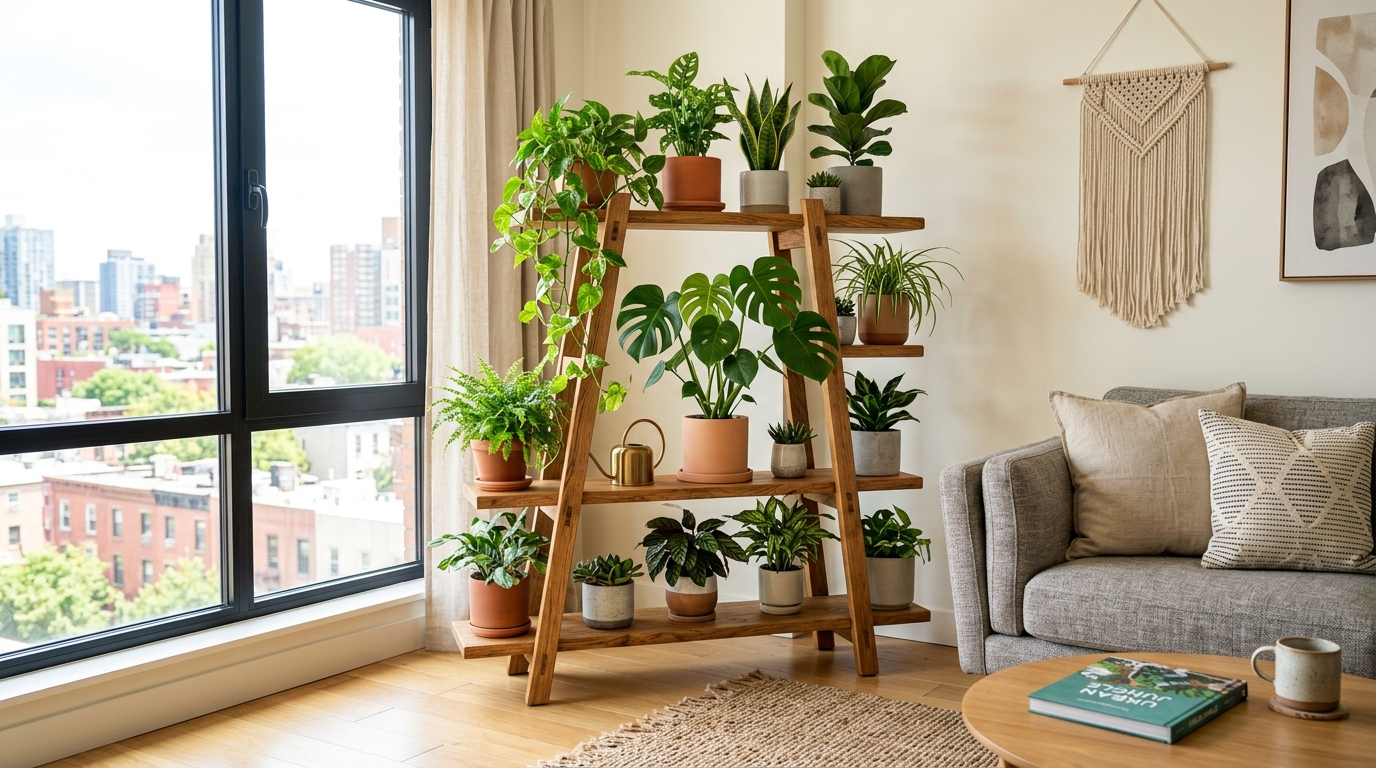
I bought a basic five-step wooden ladder from a hardware store for $15.00 and converted it into a plant stand by attaching wooden planks across the steps.
Materials: Five-step wooden ladder ($15.00), three wooden planks (40 cm by 15 cm by 2 cm, $1.00 each from a hardware store offcut bin). Total: $18.00.
Build steps: I laid the ladder flat on its side so the steps faced upward. I placed three planks across steps 2, 3, and 4 (skipping step 1 because it was too narrow and step 5 because it was too close to the floor). I screwed each plank to the step edges using four 2 cm wood screws per plank. The result is a three-shelf unit with shelf heights of approximately 45 cm, 80 cm, and 115 cm above the floor.
Dimensions: 40 cm wide at shelves, 35 cm deep (ladder base), 150 cm tall (when stood upright). Each shelf holds one to two pots depending on size.
Results: I positioned this stand 60 cm from the south-west window with the shelves facing the light. The top shelf (115 cm) receives 3,800 lux at peak, the middle (80 cm) receives 2,400 lux, and the bottom (45 cm) receives 1,200 lux. This stand holds my Rubber Tree (Ficus elastica) on the top shelf, a Monstera cutting on the middle, and a Snake Plant (Sansevieria trifasciata) on the bottom. After 12 weeks, the Rubber Tree added 15 cm of height, the Monstera produced two fenestrated leaves, and the Snake Plant produced one new leaf. According to the RHS houseplant guide, these light levels match the recommended ranges for each species.
Stand Design 4: The Window-Sill Extension Bracket ($4.00)
This is not a traditional stand but rather a bracket that extends your existing window sill outward by 15 cm, creating a narrow shelf that sits in the highest-light zone of any room.
Materials: Two L-brackets (15 cm arm length, rated for 10 kg each, $1.50 each), one wooden plank (60 cm by 15 cm by 2 cm, $1.00). Total: $4.00.
Build steps: Mount the two L-brackets on the wall directly below your window sill, spaced 50 cm apart. Attach the wooden plank to the brackets. The plank now extends 15 cm outward from the wall at window-sill height, creating a narrow shelf that receives nearly the same light intensity as the window sill itself.
Results: The extended shelf receives 7,800 lux at peak in my south-west window, compared to 8,500 lux on the actual window sill. This is enough light for succulents, cacti, and herbs that require direct sun. I placed three small succulent pots (8 cm diameter each) on this shelf and they maintained compact, colourful growth over 10 weeks. The Texas A&M AgriLife Extension recommends placing succulents within 30 cm of a south or west window for adequate light, and this bracket achieves that positioning without occupying floor space.
Comparing All Four Stands
| Stand | Cost | Max Height | Pot Capacity | Peak Lux at Top |
|---|---|---|---|---|
| PVC Pipe Tiered | $8.50 | 150 cm | 3 pots | 5,200 lux |
| Milk Crate Stack | $6.00 | 75 cm | 3 pots | 1,400 lux |
| Ladder Shelf | $18.00 | 115 cm (top shelf) | 5-6 pots | 3,800 lux |
| Window-Sill Extension | $4.00 | Window-sill height | 3 small pots | 7,800 lux |
The window-sill extension bracket delivers the highest light intensity at the lowest cost but holds only small pots. The ladder shelf holds the most plants and looks the most like furniture. The PVC stand offers the best balance of height, capacity, and cost. The milk crate is the quickest and cheapest option for medium-light plants. Learn more in our article about mapping your apartment light zones You might find our guide on free indoor light estimator
🌱 Pro Tip: Before building any stand, measure the light intensity at the height you plan to place your plants. Use a free lux meter app on your phone and take a reading at the exact height and distance from the window where the stand's top shelf will be. If the reading is below 1,000 lux, aim for a taller stand. If it is above 3,000 lux, even a short stand will work. I wasted $12 on a stand that placed my plants at 700 lux — a height I could have achieved with books for free.
Frequently Asked Questions
Q: How tall should a plant stand be for maximum sunlight?
A: Aim for the stand's top shelf to be at or slightly above your window-sill height. In my apartment, window-sill height is 90 cm, and the stands that placed plants at 90 to 150 cm produced the best growth. Stands below 60 cm only marginally improve light access compared to floor level.
Q: Can I put a heavy pot on a DIY stand?
A: Check the weight rating of your brackets and materials. The PVC stand holds pots up to 5 kg safely. The ladder shelf holds up to 15 kg on its top shelf. The milk crate holds up to 8 kg. The window-sill extension bracket holds up to 3 kg if mounted with wall anchors. For pots over 15 kg, use a solid commercial stand rated for the weight.
Q: Will a plant stand block light from reaching the rest of the room?
A: If the stand is placed to the side of the window (not directly in front), it blocks minimal light. I position all my stands within 30 to 60 cm of the window but offset to the left or right of the glass. This placement keeps the window's light path clear while giving the plants on the stand maximum exposure.