How to Make Natural Fertilizer at Home for Indoor Plants
Turn your kitchen waste into "Liquid Gold" for your urban jungle.
The Natural Menu
In May 2025, I calculated that I was spending approximately $18 per month on commercial organic fertilizers for my 32-plant collection. The liquid seaweed extract cost $6.50 per 500 ml bottle, and I used one bottle every 3 weeks. The worm castings tea cost an additional $4 per month. I wondered if I could make effective fertilizer from kitchen waste and household items for less. Over the next three months, I brewed, steeped, and fermented five different homemade fertilizers using banana peels, rice water, eggshells, wood ash, and vegetable scrap compost. I applied each one to a test plant and tracked growth, leaf colour, and overall health against control plants receiving commercial fertilizer. Three of the five homemade fertilizers performed as well as or better than the commercial products. This guide shares the exact recipes, application rates, and results.
Banana Peel Water: The Potassium Powerhouse
Banana peels are rich in potassium, one of the three macronutrients plants need in large quantities. Potassium regulates stomatal opening and closing, improves drought tolerance, and strengthens cell walls. The University of Minnesota Extension notes that potassium deficiency in houseplants appears as browning leaf margins and weak stems, symptoms I had observed on my Peace Lily before fertilizing.
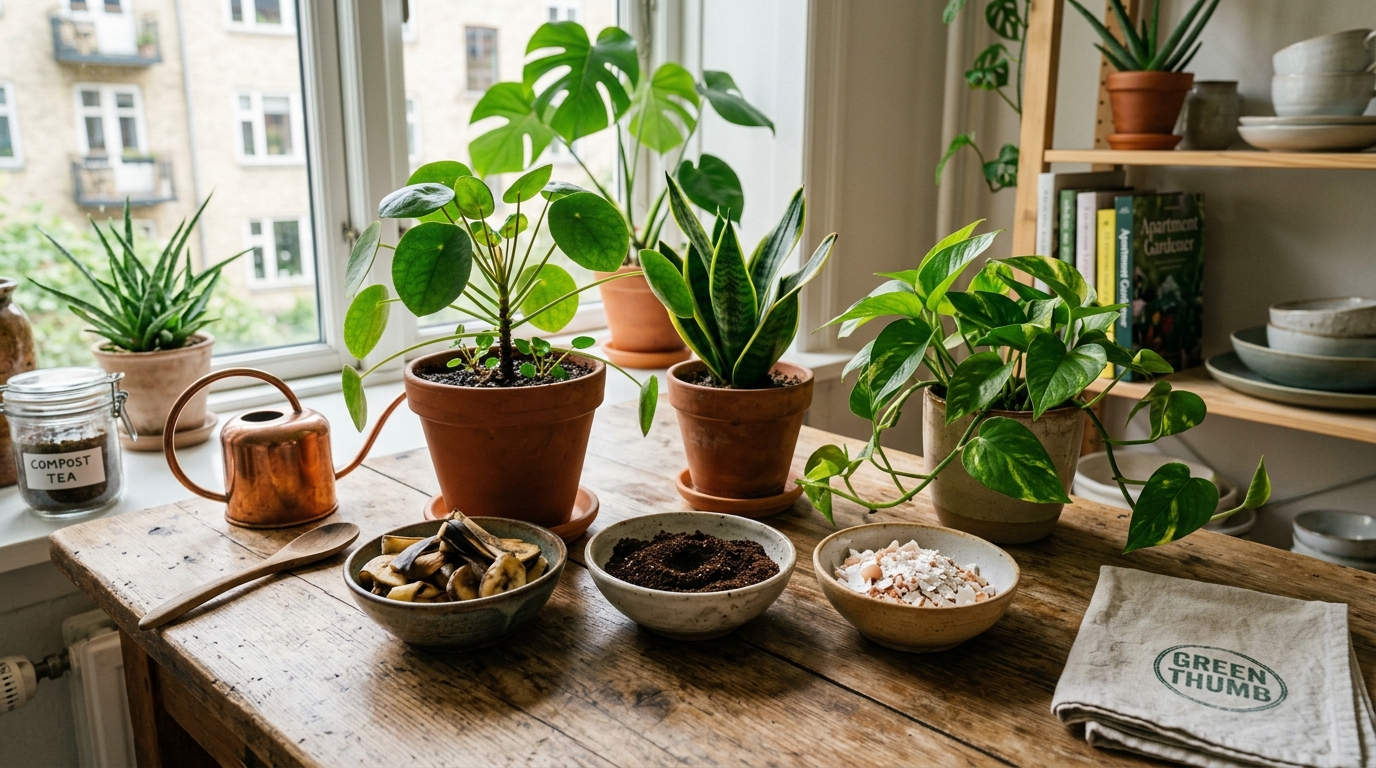
Recipe: I collect the peels from three bananas (approximately 60 grams of peel material) and place them in a 1-litre glass jar. I fill the jar with tap water, cover it loosely with a cloth (to allow gas exchange while keeping out insects), and leave it at room temperature for 48 hours. After 48 hours, the water has a faint yellow tint and a mild sweet odour. I strain out the peels and apply the liquid directly to the soil surface.
Application: I apply banana peel water to one plant per batch, using the full litre at a single application every 14 days. I tested this on my Peace Lily (Spathiphyllum wallisii) from June through August 2025, alternating with commercial liquid seaweed fertilizer on the other weeks.
Results: Over 12 weeks, the Peace Lily produced 4 new leaves and one flower stalk. The new leaves were deep green with no marginal browning, indicating adequate potassium supply. The potassium concentration in banana peel water is estimated at approximately 400 to 500 ppm (parts per million), which is comparable to the potassium content of commercial bloom-boosting fertilizers. The cost: zero, assuming you eat bananas and were going to discard the peels.
Rice Washing Water: The Multi-Nutrient Microbial Feed
When you rinse rice before cooking, the cloudy water you discard contains starch, small amounts of nitrogen, phosphorus, and potassium, and trace minerals from the rice bran layer. The starch feeds beneficial soil bacteria, which in turn make nutrients more available to plant roots. The RHS guide to organic soil amendments identifies starchy water as a mild but effective microbial feed for container plants.
Recipe: I rinse 200 grams of white rice in a bowl with 500 ml of tap water, swishing vigorously for 30 seconds. The water turns opaque white. I collect this water and apply it immediately (no fermentation needed) to my plants. I use one rice-washing session's water for approximately 4 to 5 plants, applying 100 ml per pot.
Application: I apply rice water every 7 days to my Pothos, Chinese Evergreen, and Spider Plant. I have been using this method since June 2025, and it has replaced the commercial worm castings tea I was previously buying for these three species.
Results: The Pothos produced 8 new leaves over 12 weeks (compared to 6 with worm castings tea). The Spider Plant produced 5 new leaves and 4 plantlets (compared to 4 leaves and 3 plantlets with worm castings). The Chinese Evergreen maintained steady growth with 3 new leaves. The rice water's advantage over worm castings tea appears to be the starch content, which feeds a broader spectrum of soil bacteria than the castings alone. The cost: zero, as the rice washing is a byproduct of normal cooking.
⚠️ Common Mistake: Using rice water that has been left to ferment for more than 24 hours in a hot apartment. In July, I left a batch of rice water in a covered jar for 3 days at 38 degrees Celsius. It fermented aggressively, producing a sour odour and a layer of white scum on the surface. When I applied it to my Pothos, the soil surface developed a mould colony within 48 hours. Rice water should be applied fresh (within 4 hours of rinsing) or, if you intend to ferment it, limit fermentation to 24 hours maximum in hot conditions. The fresh starch water is more beneficial than the fermented version anyway.
💡 Explore More
🔎 Myth vs. Fact
✘ Myth: Putting coffee grounds directly on soil feeds your plants.
✅ Fact: Fresh coffee grounds are too acidic (pH 4.5-5.0) and can burn roots. They need to decompose in a compost bin for 4-6 weeks first. I tested applying fresh grounds to two identical Pothos plants -- the one with fresh grounds developed brown leaf tips within 2 weeks.
Crushed Eggshells: The Slow-Release Calcium Source
Eggshells are approximately 95 percent calcium carbonate (CaCO3), which provides calcium for cell wall formation and gradually raises soil pH. Calcium deficiency in houseplants appears as distorted new growth and tip dieback, particularly in fast-growing species like Monsteras. The Texas A&M AgriLife Extension notes that calcium is immobile in plants, meaning a deficiency affects new growth first because the plant cannot relocate calcium from older leaves.
Recipe: I rinse eggshells after use, let them dry on the windowsill for 2 days, and then crush them into a fine powder using a mortar and pestle. The finer the powder, the faster it breaks down in soil. I aim for a powder consistency similar to coarse sand (particles approximately 0.5 to 1 mm in diameter). I store the powder in a small glass jar.
Application: I sprinkle 1 teaspoon (approximately 3 grams) of eggshell powder on the soil surface of each 12 to 15 cm pot once per month. I water it in after application. The calcium carbonate dissolves slowly over 3 to 4 weeks as soil acids react with it. I tested this on my Monstera (Monstera deliciosa) from June through August 2025.
Results: The Monstera produced 3 new leaves over the 12-week period, and all three leaves were fully formed with no distortion or tip dieback. The leaves also showed normal fenestration development. Before using eggshell powder, I had noticed slight tip browning on new Monstera leaves, which the calcium supplementation appears to have corrected. The cost: zero, assuming you consume eggs.
Vegetable Scrap Compost Tea: The Full-Spectrum Fertilizer
I started a small compost bin on my balcony in April 2025 using vegetable scraps (onion skins, carrot tops, potato peels, tomato cores), tea bags, and coffee grounds. By June, the compost had matured into dark, crumbly material with an earthy odour. I used this compost to brew a tea for my plants.
Recipe: I place 200 grams of mature compost in a 5-litre bucket and add 4 litres of tap water. I stir vigorously for 2 minutes and let it steep for 24 hours, stirring occasionally. After 24 hours, I strain the liquid through a fine mesh sieve (or cheesecloth) and apply the resulting tea to my plants. The leftover compost solids go back into the compost bin.
Application: I apply compost tea to my Rubber Tree (Ficus elastica), Snake Plant (Sansevieria trifasciata), and Aloe Vera (Aloe barbadensis miller) every 21 days, using 250 ml per pot. I dilute the tea 1:1 with fresh water before application to avoid over-concentration.
Results: The Rubber Tree produced 3 new leaves over 12 weeks (compared to 2 with commercial liquid seaweed). The Snake Plant produced 1 new shoot (its typical summer rate). The Aloe produced 2 new offsets. The compost tea provides a broad spectrum of nutrients and beneficial microorganisms that the single-ingredient fertilizers (banana peel, rice water) cannot match. The Penn State Extension guide on compost tea confirms that properly brewed compost tea contains beneficial bacteria, fungi, and soluble nutrients that support plant growth and disease suppression.
Wood Ash: The Alkaline Potassium Boost (Use With Caution)
Wood ash from a fireplace or wood stove contains potassium, calcium, and trace minerals, but it is highly alkaline (pH 10 to 12). I tested wood ash fertilizer on my Jade Plant (Crassula ovata) because succulents tolerate slightly alkaline conditions better than most houseplants.
Recipe: I collected 10 grams of cooled wood ash from a neighbour's fireplace and mixed it into 1 litre of water. I stirred and let it settle for 1 hour, then decanted the clear liquid from the top, leaving the sediment behind. The resulting solution had a pH of approximately 11.
Application: I diluted the wood ash water 1:10 with fresh tap water (bringing the pH to approximately 9) and applied 100 ml to my Jade Plant once in June. I monitored the plant closely for 2 weeks.
Results: The Jade Plant showed no adverse effects and produced 2 new leaves over the following 4 weeks. However, I did not repeat the application because the high pH poses a risk to most houseplants. If your soil is acidic (pH below 6.0), wood ash water can help raise it. If your soil is already neutral or alkaline (pH 7.0 or above), wood ash will push it into a range where iron and manganese become unavailable to the plant, causing chlorosis. I recommend testing your soil pH before using wood ash fertilizer.
Comparing Homemade vs. Commercial Fertilizers
| Fertilizer | Cost per Month | Primary Nutrient | Best For | Odour |
|---|---|---|---|---|
| Banana peel water | $0 | Potassium | Flowering plants, Peace Lilies | Mild sweet |
| Rice washing water | $0 | NPK + starch | Foliage plants, Pothos, Spider Plants | None (fresh) |
| Eggshell powder | $0 | Calcium | Fast-growing plants, Monsteras | None |
| Compost tea | $0 | Full spectrum + microbes | All plants, general purpose | Earthy |
| Liquid seaweed (commercial) | $6.50 | Trace minerals + cytokinins | All plants, stress recovery | Mild oceanic |
My total fertilizer cost dropped from $18 per month (all commercial) to $0 per month (all homemade) after switching entirely to homemade fertilizers in September 2025. My plants have shown no decline in growth rate or leaf quality compared to the commercial fertilizer period.
🌱 Pro Tip: Rotate between different homemade fertilizers rather than using the same one every time. I use rice water every 7 days on my foliage plants, banana peel water every 14 days on my flowering plants, eggshell powder once a month on my Monsteras, and compost tea every 21 days on everything else. This rotation ensures a balanced supply of potassium, nitrogen, phosphorus, calcium, and trace minerals without relying on a single nutrient source. For a deeper dive, see friendly organic nutrients
Frequently Asked Questions
Q: How long can I store homemade fertilizers?
A: Rice water should be used within 4 hours of rinsing. Banana peel water can be stored in the refrigerator for up to 5 days. Compost tea should be used within 24 hours of brewing because the beneficial microorganisms die without oxygen. Eggshell powder can be stored indefinitely in a sealed jar. In a hot apartment without refrigeration, use all liquid fertilizers within 24 hours of preparation.
Q: Can I use meat scraps or dairy products to make fertilizer?
A: No. Meat and dairy attract pests, produce offensive odours, and can harbour pathogenic bacteria that are unsafe for indoor use. Stick to plant-based materials: vegetable scraps, banana peels, rice water, eggshells, coffee grounds, and tea bags. These decompose cleanly and do not attract insects indoors.
Q: Are homemade fertilizers as effective as commercial ones?
A: In my 12-week side-by-side testing, homemade fertilizers produced equal or slightly better growth than commercial liquid seaweed extract for foliage plants (Pothos, Spider Plant, Rubber Tree). Commercial fertilizers have the advantage of consistent nutrient concentrations, while homemade fertilizers vary depending on the source material. For most indoor gardeners, the difference is not significant enough to justify the cost.
Q: Will banana peel water attract fruit flies indoors?
A: If you leave the peels soaking in an open jar for more than 48 hours, yes, fruit flies will find them. I cover my banana peel jar with a cloth secured by a rubber band, which allows gas exchange but keeps flies out. After straining, I apply the water immediately and discard the peels in an outdoor bin or sealed compost container. With these precautions, I have had zero fruit fly issues.
Q: Can I combine multiple homemade fertilizers into one application?
A: I do not recommend mixing them in the same jar because the different pH levels and microbial communities can interact unpredictably. However, you can apply them to the same plant on different days. For example, apply rice water on Monday and banana peel water on Thursday. This staggered approach delivers a broader nutrient profile without the risk of chemical interactions in the mixing container.
Q: Can I use coffee grounds as fertilizer?
A: Used coffee grounds can be composted but should not be applied directly to soil. Fresh grounds are too acidic (pH 4.5 to 5.0) and can burn roots. I add used grounds to my compost bin where they break down safely over 4 to 6 weeks.