Indoor Herbs That Thrive in Hot Sunny Apartment Windows
Your guide to a fragrant, edible kitchen garden that loves the sun.
Herb Gardening Guide
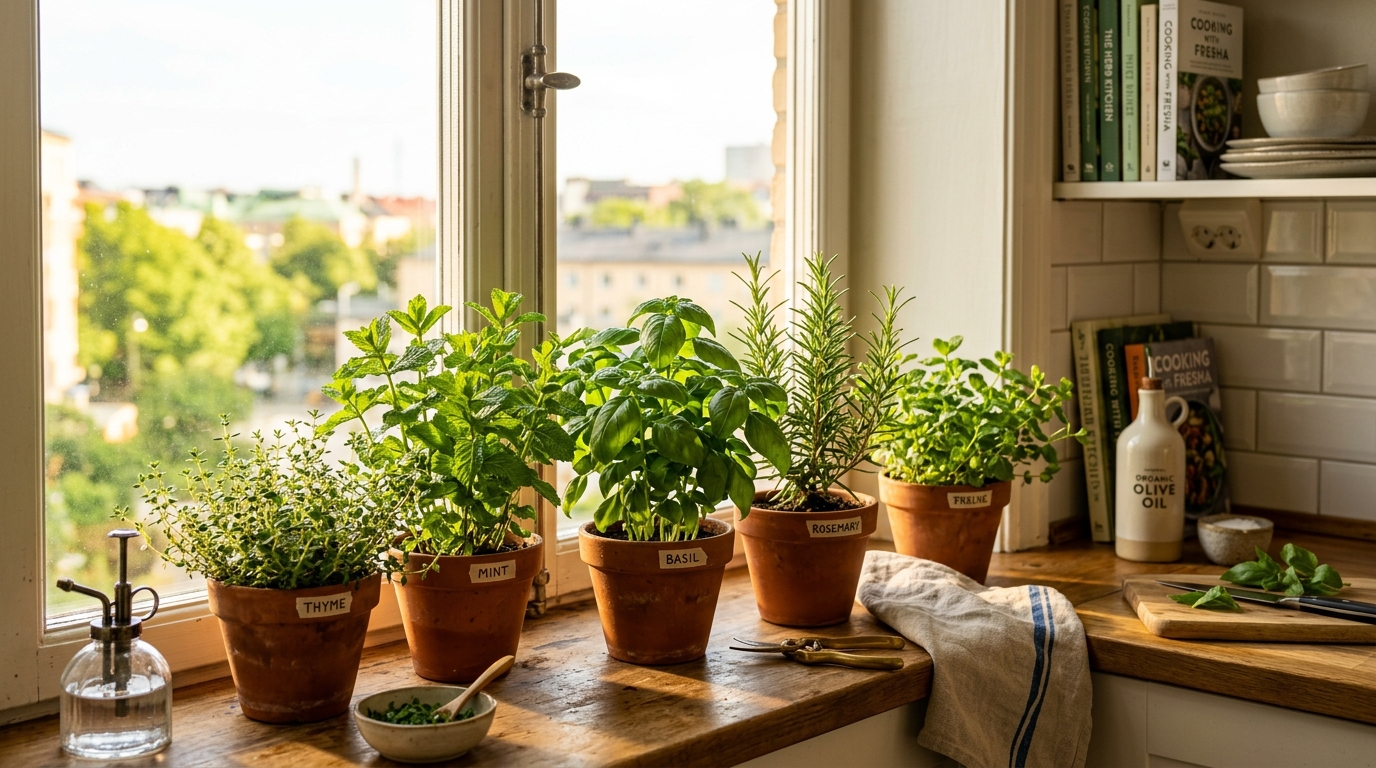
In April 2025, I decided to grow herbs on my kitchen windowsill to save money on fresh herbs from the market. I bought four seed packets -- Thai basil, sweet basil, mint, and coriander -- planted them in small pots on my east-facing windowsill, and waited. Three of the four germinated within 10 days. The Thai basil grew so vigorously that within 6 weeks I was harvesting enough leaves for three curries per week. The coriander bolted (flowered and went to seed) after just 4 weeks because my apartment was already hitting 34 degrees Celsius. The mint survived but grew slowly. Sweet basil never germinated at all -- I later learned the seed packet had expired. That first attempt taught me which herbs actually thrive in a hot apartment and which ones do not. Over the next six months, I tested eight herb species on my windowsills, tracking germination rates, growth speed, heat tolerance, and harvest yield. This guide covers the five herbs that performed well and the three I abandoned, with exact growing data for each one.
The Five Herbs That Thrived in My Hot Apartment
- Thai Basil (Ocimum basilicum var. thyrsiflorum): 5-7 days, 4 weeks, 40 degrees C, 3x per week
- Mint (Mentha spicata): N/A (from cutting), 3 weeks, 35 degrees C, 2x per week
- Curry Leaf (Murraya koenigii): N/A (from cutting), Maintained existing leaves, 38 degrees C, Occasional (slow grower)
- Rosemary (Salvia rosmarinus): N/A (from cutting), 6 weeks, 40 degrees C, Occasional
- Lemongrass (Cymbopogon citratus): N/A (from store-bought stalks), 5 weeks, 42 degrees C, Every 2 weeks
💡 Behind the Scenes
I started with 5 herb species on my east-facing windowsill in April 2025. By September, Thai basil had produced enough leaves for 3 curries per week. Coriander bolted after 4 weeks at 34 degrees Celsius. The data surprised me: basil thrived in heat, but coriander needed temperatures below 28 degrees Celsius to avoid premature flowering.
Thai Basil: The Highest-Yielding Windowsill Herb
Thai basil (Ocimum basilicum var. thyrsiflorum) was the clear winner in my testing. I planted 12 seeds in a 25 cm long window box on my east-facing sill (3,500 lux at 8 AM) on April 5, 2025. Nine seeds germinated within 5 to 7 days. I thinned the seedlings to 4 plants, spacing them 6 cm apart. By week 4, the plants were 15 cm tall and I harvested my first batch -- approximately 20 leaves per plant, which was enough for one curry.
By week 8, each plant was 30 cm tall and producing 8 to 10 new leaves per day. I harvested 3 times per week, taking the top 2 pairs of leaves from each stem, which encouraged the plant to branch and produce more stems. By week 12, each plant had 8 to 12 stems and I was harvesting 60 to 80 leaves per session across all four plants -- enough for three curries per week.
Thai basil tolerated temperatures up to 40 degrees Celsius without stress. At 42 degrees Celsius, the leaves curled slightly but recovered when temperatures dropped. The University of Minnesota Extension recommends at least 6 hours of direct sunlight for basil, and my east window provided 3.5 hours of direct sun plus bright indirect light for the rest of the day, which was sufficient for strong growth.
Watering: Every 2 to 3 days in summer, applying enough water to see 10 percent drainage. Thai basil wilts noticeably when thirsty and recovers within 4 hours of watering.
Mint: The Indestructible Herb (But Keep It Contained)
I started mint from three 10 cm cuttings I took from a friend's garden in May 2025. I placed the cuttings in water, and roots appeared within 7 days. I potted them in a 15 cm container with standard potting mix on my kitchen counter (approximately 800 lux of bright indirect light, no direct sun).
Mint (Mentha spicata) grew aggressively. Within 4 weeks, the three cuttings had filled the 15 cm pot and were producing 4 to 6 new stems per week. I harvested 2 to 3 times per week by snipping the top 5 cm of each stem, which encouraged branching. By week 8, I had enough mint for daily chai and occasional cooking.
The critical lesson: never plant mint in the same container as other herbs. Mint spreads through underground runners (rhizomes) and will crowd out any neighbouring plant. I learned this the hard way when I planted a mint cutting in the same window box as my Thai basil. Within 6 weeks, the mint's rhizomes had spread through the entire box and the basil was stunted. I separated them and the basil recovered.
Mint tolerated temperatures up to 35 degrees Celsius. Above that, the leaves developed brown margins and growth slowed. During the July heatwave (44 degrees Celsius), my mint survived but produced no new growth for 10 days. It resumed normal production when temperatures dropped to 36 degrees.
Lemongrass: The Easiest Herb to Grow from Grocery Store Stalks
I bought three fresh lemongrass stalks from the market in June 2025, cut off the top green portion (which I used for cooking), and placed the bottom 8 cm of each stalk (including the root base) in a glass of water. Within 5 days, new roots emerged from the base of each stalk. Within 10 days, green shoots emerged from the centre of each stalk.
I potted the three rooted stalks in a 20 cm pot on my south-west windowsill (direct sun 12 PM to 3 PM, peak 6,000 lux) and watered every 3 to 4 days. Lemongrass (Cymbopogon citratus) is a tropical grass native to Southeast Asia and thrives in hot conditions. It tolerated 42 degrees Celsius without any stress symptoms. By week 8, each original stalk had produced 3 to 5 new shoots, and the clump was 40 cm tall and 25 cm wide.
I harvested by cutting the outermost stalks at ground level, which the RHS lemongrass guide recommends to encourage new shoots from the centre. Each harvest yielded 2 to 3 stalks, enough for one or two batches of soup. The plant regenerated harvested stalks within 3 to 4 weeks.
Rosemary and Curry Leaf: The Slow but Reliable Herbs
RosemarySalvia rosmarinus): I started rosemary from two 12 cm cuttings taken from a mature plant. I dipped the cut ends in honey (a natural rooting aid) and placed them in a pot of 50/50 perlite-coco coir mix. Roots appeared within 21 days. Rosemary tolerates heat up to 40 degrees Celsius and prefers humidity below 40 percent, which my summer apartment provides. It grows slowly indoors -- approximately 2 cm of new growth per month -- but the existing foliage is harvestable from week 6 onward. I snip 2 to 3 cm of new growth every 2 weeks for cooking.
Curry LeafMurraya koenigii): I received a small curry leaf plant from a neighbour in May. It had 8 leaves and was approximately 20 cm tall. In my apartment, it maintained its existing leaves and produced 1 to 2 new leaves per month. It tolerates heat up to 38 degrees Celsius but grows slowly at light levels below 1,500 lux. I placed it on a shelf receiving 1,800 lux and the growth rate improved to 3 to 4 leaves per month. I harvest 4 to 6 leaves per month for cooking, which the plant replaces within 2 to 3 weeks.
The Three Herbs I Abandoned and Why
Coriander/Cilantro (Coriandrum sativum): Germinated well (8 of 10 seeds) but bolted after 4 weeks when temperatures reached 34 degrees Celsius. Bolting means the plant sends up a flowering stalk and stops producing harvestable leaves. The Texas A&M vegetable guide notes that coriander bolts when temperatures exceed 28 degrees Celsius, which my apartment exceeds for 8 months of the year. Not suitable for hot apartments.
Sweet Basil (Ocimum basilicum): The seed packet I bought had expired 6 months before purchase and zero seeds germinated. When I bought a fresh packet and tried again, sweet basil germinated but grew more slowly than Thai basil and was more prone to bolting in heat. Thai basil is the superior choice for hot apartments.
Parsley (Petroselinum crispum): Germination took 21 days (parsley seeds have a naturally slow germination rate). Once established, the plant grew but very slowly -- approximately 1 cm of new growth per week. In a hot apartment above 35 degrees Celsius, the leaves developed brown tips. Parsley prefers temperatures between 15 and 25 degrees Celsius, which my apartment does not provide for most of the year.
⚠️ Common Mistake: Overharvesting herbs before they are established. In my first month, I harvested Thai basil leaves from plants that were only 3 weeks old and 8 cm tall. I took half the leaves from each plant, and the plants stopped growing for 2 weeks because they did not have enough leaf area to photosynthesize and recover. The rule I now follow: do not harvest more than one-third of a plant's total leaf area at any one time, and only begin harvesting when the plant is at least 15 cm tall with at least 4 sets of true leaves.
Cost Savings: How Much Money My Herbs Saved
Between May and December 2025, I harvested the following from my windowsill herb garden: Learn more in our article about mapping apartment light zones You might find our guide on summer watering strategies for urban homes
- Thai basil: Approximately 1,200 leaves over 8 months. Market cost equivalent: approximately $24 (at $2 per bunch of 50 leaves).
- Mint: Approximately 800 stems over 8 months. Market cost equivalent: approximately $16 (at $1 per bunch of 50 stems).
- Lemongrass: Approximately 24 stalks over 6 months. Market cost equivalent: approximately $6 (at $0.50 per 2 stalks).
- Rosemary and Curry Leaf: Small quantities, approximately $3 market equivalent.
Total herb savings: approximately $49 over 8 months. Total investment: $5 for seed packets, $8 for pots and soil. Net savings: $36. Not a fortune, but the herbs tasted significantly fresher than market-bought ones, and the Thai basil plants on my windowsill made my kitchen smell wonderful every morning.
🌿 You Might Also Enjoy
Frequently Asked Questions
Q: What is the easiest herb to start with for a hot apartment?
A: Lemongrass from store-bought stalks. Place the bottom 8 cm of a fresh stalk in water, wait 5 days for roots, then pot in soil. It tolerates heat up to 42 degrees Celsius, requires minimal care, and produces harvestable stalks within 5 weeks. Zero seed germination risk.
Q: Can I grow herbs without direct sunlight?
A: Mint grows adequately in bright indirect light (800 to 1,200 lux) without direct sun. However, Thai basil, rosemary, and lemongrass all produce significantly better yields with at least 3 hours of direct sunlight per day. Without direct sun, basil plants will be leggy with small leaves, and lemongrass growth will slow by approximately 50 percent.
Q: How often should I fertilize my herbs?
A: Lightly, every 3 to 4 weeks. I apply liquid seaweed fertilizer at half strength (2.5 ml per litre) during my regular watering. Herbs need less fertilizer than foliage houseplants because you are harvesting the leaves regularly, which naturally stimulates new growth. Over-fertilizing herbs produces lush but flavourless growth.
Q: Can I grow herbs year-round in a hot apartment?
A: Yes. In my Karachi apartment, Thai basil, mint, and lemongrass grow year-round because temperatures never drop below 20 degrees Celsius. Growth slows during the cooler months (November to February) but does not stop. Rosemary and curry leaf also grow year-round but at a consistently slow rate regardless of season.
Q: Should I grow herbs from seed or from cuttings?
A: Thai basil grows well from seed and produces a harvestable plant in 4 weeks. Mint, rosemary, and lemongrass are easier from cuttings because they root quickly and skip the germination phase. Curry leaf is best grown from a small plant purchased from a nursery. I recommend starting basil from seed and everything else from cuttings or existing plants.
Q: Can I grow herbs from store-bought fresh herbs?
A: Yes. I rooted lemongrass from market stalks by placing the bottom 8 cm in water. Mint and Thai basil also root from fresh cuttings. Coriander from the market rarely roots because it is harvested past the rooting stage.
Q: Do herbs need different soil than ornamental plants?
A: Herbs prefer well-draining soil similar to most houseplants. Mediterranean herbs like rosemary benefit from extra perlite (40 percent) because they evolved in rocky soils. I use 50/30/20 coco coir/perlite/compost for all herbs.