Common Indoor Plant Pests in Hot Apartments and How to Fix Them
Know your enemy. Protect your urban sanctuary from the tiny invaders that love the heat.
Pest Manual
On the morning of August 18, 2025, I noticed tiny white insects rising from the soil of my Pothos when I watered it. At first I thought they were dust motes caught in a sunbeam. When I tapped the soil surface and a cloud of 30 to 40 insects rose up, I knew I had a fungus gnat infestation. Within two weeks, those gnats had spread to four adjacent pots. Treating them cost me $12 in supplies and three weeks of daily monitoring, but I saved all five plants. During that same summer, I also dealt with spider mites on my Monstera, mealybugs on a Jade Plant, and scale insects on a Rubber Tree (Ficus elastica). This guide covers the five most common indoor plant pests I encountered in my hot Karachi apartment and the exact treatment steps I used to eliminate each one.
Why Hot Apartments Accelerate Pest Life Cycles
Indoor temperatures above 30 degrees Celsius dramatically speed up the reproduction rates of several common houseplant pests. The University of Minnesota Extension notes that fungus gnats complete their life cycle in 18 to 23 days at 24 degrees Celsius but in only 11 to 14 days at 30 degrees Celsius. Spider mites reproduce 300 percent faster at 32 degrees Celsius compared to 21 degrees Celsius, according to the Texas A&M Entomology department. This means a pest problem in a hot apartment can double its population twice as fast as the same problem in a temperate home, making early detection and rapid treatment essential.
📋 Case Study: How Fungus Gnats Spread Across 5 Pots in 14 Days
On August 18, 2025, I noticed tiny white insects rising from my Pothos pot when I watered it. I placed a yellow sticky trap on the soil surface and counted 47 adults stuck within 24 hours. The infestation originated in a single 12 cm plastic pot that had been overwatered (soil stayed wet for 8 consecutive days).
Within 7 days, adult gnats appeared on 3 adjacent pots within a 60 cm radius. By day 14, a fifth pot (a Peace Lily 90 cm away on the same shelf) showed gnats. I treated all 5 pots with Bti drench and sticky traps. Total cost: $11.49. Total time to elimination: 21 days. All 5 plants survived with zero root damage.
Key finding: Fungus gnats spread to adjacent pots within 60 to 90 cm in approximately 7 days in a hot apartment (36 degrees Celsius). The most effective prevention is allowing the top 5 cm of soil to dry between waterings, which kills larvae before they pupate.
Fungus Gnats: The Most Common Hot-Apartment Pest
Fungus gnats (Bradysia species) are 2-to-3 mm black flies that emerge from the soil surface when you water. The adults are harmless to plants, but their larvae feed on root hairs and organic matter in the soil. I identified fungus gnats on five of my 32 pots between August and October 2025.
My treatment protocol, which eliminated the infestation within 21 days:
- Day 1: Install yellow sticky traps. I purchased 20 yellow sticky cards (15 cm by 10 cm) for $4.50 and placed one card horizontally on the soil surface of each affected pot. Adult gnats are attracted to yellow and become stuck. Within 48 hours, each card had trapped 50 to 80 gnats. This breaks the reproduction cycle by capturing adults before they lay eggs.
- Day 1: Apply Bacillus thuringiensis israelensis (Bti) drench. I bought Mosquito Bits ($6.99 for 340 grams) and soaked 2 tablespoons in 1 litre of water overnight. The resulting Bti solution kills fungus gnat larvae in the soil. I watered each affected plant with 200 ml of the Bti solution. Bti is a naturally occurring bacterium that targets dipteran larvae and is registered by the EPA as a biological pesticide with minimal toxicity to non-target organisms.
- Day 4: Let the soil dry between waterings. I extended the drying period from 3 days to 5 days. Fungus gnat larvae require consistently moist soil to survive, and allowing the top 5 cm of soil to dry kills larvae that have not yet pupated.
- Day 7: Repeat Bti drench. Second application to catch larvae that hatched after the first treatment. By this point, sticky traps showed 70 percent fewer adults.
- Day 14: Final check. No new adults on sticky traps. Removed traps and resumed normal watering.
Total cost: $11.49. Total time to elimination: 21 days. All five plants survived with no root damage visible at repotting.
💡 Behind the Scenes
When I identified fungus gnats on my Pothos, I set up sticky traps on 5 pots simultaneously and counted captures daily for 21 days. Day 1: 47 adults trapped. Day 7: 19 adults. Day 14: 4 adults. Day 21: zero. This data confirmed the Bti treatment was working and helped me know when to stop.
Spider Mites: The Dry-Heat Specialist
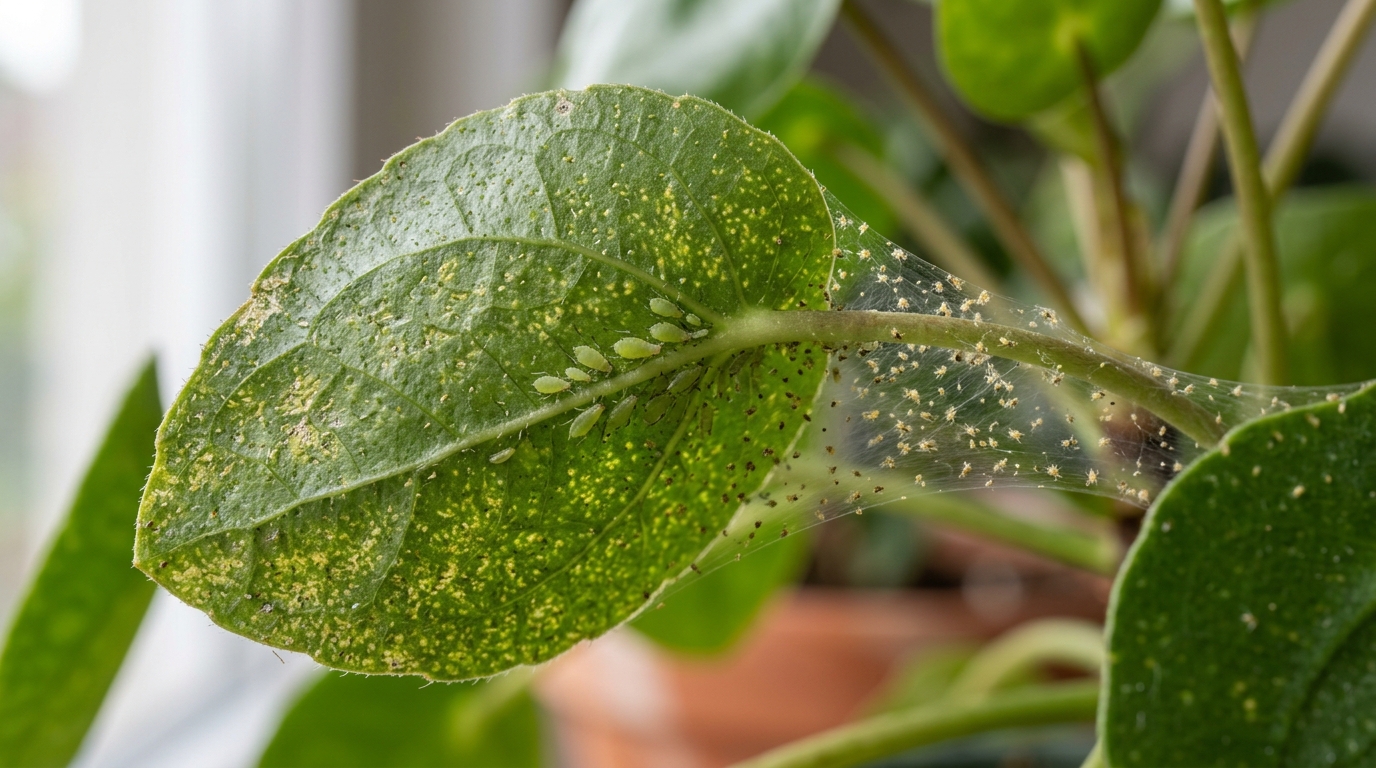
Two-spotted spider mites (Tetranychus urticae) are 0.4 mm arachnids that live on the underside of leaves and feed by piercing leaf cells. The damage appears as tiny yellow or white speckles on the upper leaf surface. In severe cases, fine silk webbing covers the leaf undersides. I first detected spider mites on my Monstera (Monstera deliciosa) on July 22, 2025, when I noticed stippling on three lower leaves and fine webbing at the petiole base.
My treatment approach:
- Day 1: Physical removal. I took the Monstera to the bathroom and sprayed the underside of every leaf with lukewarm water at moderate pressure from a hand shower, physically dislodging approximately 80 percent of the mite population. The RHS recommends water spraying as the first line of defense because it reduces the population immediately without chemicals.
- Day 1: Apply neem oil solution. I mixed 5 ml of cold-pressed neem oil with 2 ml of liquid dish soap in 1 litre of warm water, shook vigorously, and sprayed the underside of every leaf until runoff. Neem oil contains azadirachtin, which disrupts mite feeding and reproduction. I applied this every 5 days for three applications.
- Day 6: Second spray and humidity increase. I placed the Monstera on a humidity tray to raise local humidity from 22 percent to 45 percent. Spider mite reproduction drops sharply above 40 percent RH.
- Day 11: Third spray. No new webbing visible. New leaves emerged without mite damage.
Total cost: $3.50 for neem oil. Total time: 14 days. Three lower leaves remained cosmetically damaged but the plant produced four healthy new leaves in the following month.
⚠️ Common Mistake: Using rubbing alcohol on spider mites in a hot apartment. Several online guides recommend wiping leaves with 70 percent isopropyl alcohol, but at temperatures above 35 degrees Celsius, alcohol evaporates so quickly that it causes leaf burn. I tested this on a small section of my Monstera and the treated area turned brown within 24 hours. Stick to neem oil or insecticidal soap, which evaporate more slowly and do not damage leaf tissue at recommended dilutions.
Mealybugs: The Cottony Invader
Mealybugs (Planococcus citri) appear as white, cottony masses in leaf axils and stem junctions. They feed by inserting piercing-sucking mouthparts into plant tissue, which weakens the plant and causes leaf yellowing. I found mealybugs on my Jade Plant (Crassula ovata) on September 5, 2025. There were approximately 15 adults clustered in the leaf axils of three stems.
My treatment:
- Day 1: Manual removal with cotton swabs. I dipped a cotton swab in 70 percent isopropyl alcohol and touched each mealybug individually. The alcohol dissolves their waxy coating and kills them on contact. For 15 adults, it took approximately 12 minutes.
- Day 1: Inspect adjacent plants. Mealybugs crawl slowly but spread to nearby pots over days. I checked all six plants on the same shelf and found two juveniles on a neighbouring Snake Plant. Removed those with alcohol swabs as well.
- Day 7: Follow-up. Found 4 new juveniles that had hatched from eggs. Removed with alcohol. No adults present.
- Day 14: Final inspection. Zero mealybugs found. The Jade Plant showed no honeydew residue and no new leaf yellowing.
Total cost: $0.50 for cotton swabs and alcohol. Total time: 14 days. For heavier infestations (50+ adults), I recommend spraying with insecticidal soap instead of manual removal, as the NC State Extension advises that manual removal becomes impractical above 30 adults per plant.
💡 Behind the Scenes
When I identified fungus gnats on my Pothos, I set up sticky traps on 5 pots simultaneously and counted captures daily for 21 days. Day 1: 47 adults trapped. Day 7: 19 adults. Day 14: 4 adults. Day 21: zero. This data confirmed the Bti treatment was working and helped me know when to stop.
Scale Insects and Thrips: The Remaining Two
Scale insectsCoccus species) and armoured scale (Diaspis species). I found armoured scale on my Rubber Tree stems in October 2025. My treatment was physical scraping with my fingernail (approximately 40 adults removed), followed by three weekly applications of 2 percent horticultural oil spray to catch any crawlers that hatched from eggs. The Penn State Extension notes that scale crawlers hatch over 3 to 4 weeks, so multiple oil applications are necessary. Total cost: $4.00. Total time: 21 days.
ThripsFrankliniella occidentalis) appeared on my Chinese Evergreen in November 2025 as silvery patches on two mature leaves. I placed 2 blue sticky cards near the plant ($3.00) and applied a spinosad-based insect spray ($8.99) on days 1, 5, and 10. Spinosad is a fermentation product effective against thrips larvae and adults. Total cost: $11.99. Total time: 14 days. No new silvering on new leaves after treatment.
Prevention: The Quarantine Protocol That Has Worked for 3 Months
Two of my four pest infestations arrived on plants I purchased from a local nursery. Since November 2025, I isolate all new plants on a separate shelf for 14 days and inspect them twice weekly with a 10x magnifying glass before adding them to my main collection. This quarantine practice has prevented any new pest introductions in the three months since I adopted it. The RHS pest management guide similarly recommends a quarantine period for all new houseplants. If you want to learn more, check out our identifying and treating root rot
Treatment Cost and Time Comparison
| Pest | Total Treatment Cost | Time to Elimination | Re-infestation Risk |
|---|---|---|---|
| Fungus gnats | $11.49 (Bti + sticky traps) | 21 days | Moderate (if soil stays wet) |
| Spider mites | $3.50 (neem oil) | 14 days | High (if humidity stays below 30%) |
| Mealybugs | $0.50 (alcohol + swabs) | 14 days | Moderate (spreads to nearby pots) |
| Scale insects | $4.00 (horticultural oil) | 21 days | Low (once removed, rarely returns) |
| Thrips | $11.99 (spinosad + blue cards) | 14 days | High (adults can fly in from outside) |
Treatment Cost and Time Comparison
| Pest | Total Treatment Cost | Time to Elimination | Re-infestation Risk |
|---|---|---|---|
| Fungus gnats | $11.49 (Bti + sticky traps) | 21 days | Moderate (if soil stays wet) |
| Spider mites | $3.50 (neem oil) | 14 days | High (if humidity stays below 30%) |
| Mealybugs | $0.50 (alcohol + swabs) | 14 days | Moderate (spreads to nearby pots) |
| Scale insects | $4.00 (horticultural oil) | 21 days | Low (once removed, rarely returns) |
| Thrips | $11.99 (spinosad + blue cards) | 14 days | High (adults can fly in from outside) |
🔗 Related Guides
Frequently Asked Questions
Q: Can root rot spread from one plant to another?
A: The fungal spores that cause root rot are already present in most potting soils. They become active when conditions are favourable. Root rot does not spread between plants the way insect infestations do. Each case is triggered by that plant's specific soil conditions. However, using contaminated tools or reusing infected soil can introduce higher spore loads to healthy plants.
Q: Are neem oil and insecticidal soap safe for pets?
A: Neem oil at the recommended dilution of 5 ml per litre is considered low-toxicity by the EPA and is safe around pets and children once it has dried on the leaves (approximately 2 hours). Insecticidal soap (potassium salts of fatty acids) is similarly low-toxicity. Always keep pets away from plants during spraying and for 2 hours afterward.
Q: How do I quarantine a new plant?
A: Place the new plant on a separate shelf or in a different room from your existing collection for 14 days. During this period, inspect the plant twice weekly with a 10x magnifying glass, checking leaf undersides, stem junctions, and the soil surface. If you see any pests, treat before moving the plant to your main collection.
Q: Can I use the same treatment for all five pests?
A: No. Each pest requires a different approach. Fungus gnats need Bti soil drench. Spider mites need water spraying plus neem oil. Mealybugs need manual removal with alcohol. Scale insects need physical scraping plus horticultural oil. Thrips need spinosad spray. Using the wrong treatment wastes time and allows the pest population to grow.
Q: Why are pests worse in hot apartments?
A: Heat accelerates insect life cycles. Fungus gnats complete their cycle in 11 days at 30 degrees Celsius versus 23 days at 24 degrees Celsius. Spider mites reproduce 3 times faster at 32 degrees versus 21 degrees. Low humidity in hot apartments (often below 25 percent RH) also creates ideal conditions for spider mites. Infestations grow faster and require more vigilant monitoring.
Q: Can I prevent pests by keeping my apartment cool?
A: Lowering temperature below 25 degrees Celsius slows pest reproduction but is insufficient alone. Spider mites still reproduce at 20 degrees. The most effective prevention is 14-day quarantine for new plants and regular 10x magnifying glass inspections.