Sunburn in Indoor Plants: How to Protect Your Greenery
Too much of a good thing. Learn how to shield your plants from the summer bake.
The Shielding Guide
On the morning of August 3, 2025, I moved my Chinese Evergreen (Aglaonema commutatum) 'Silver Bay' from a north-facing shelf (320 lux) directly onto a position 20 cm from my south-west window where the peak light intensity was 8,500 lux. I wanted it to get "more light" after reading that Chinese Evergreens prefer medium to bright indirect light. Within 48 hours, the three leaves facing the window developed large bleached-white patches in their centres, surrounded by brown, crispy margins. The tissue in those patches was dead -- not diseased, not pest-damaged, but killed by excessive light intensity. I had given the plant the equivalent of a human with pale skin spending eight hours on a tropical beach without sunscreen. It took the Chinese Evergreen six weeks to produce replacement leaves for the damaged ones. That experience taught me that sunburn on indoor plants is real, it happens faster than most people realize, and the recovery takes significantly longer than the damage takes to appear. This guide covers how to identify sunburn, which plants are most vulnerable, and the exact steps I take to protect my collection during high-light periods.
What Plant Sunburn Actually Looks Like
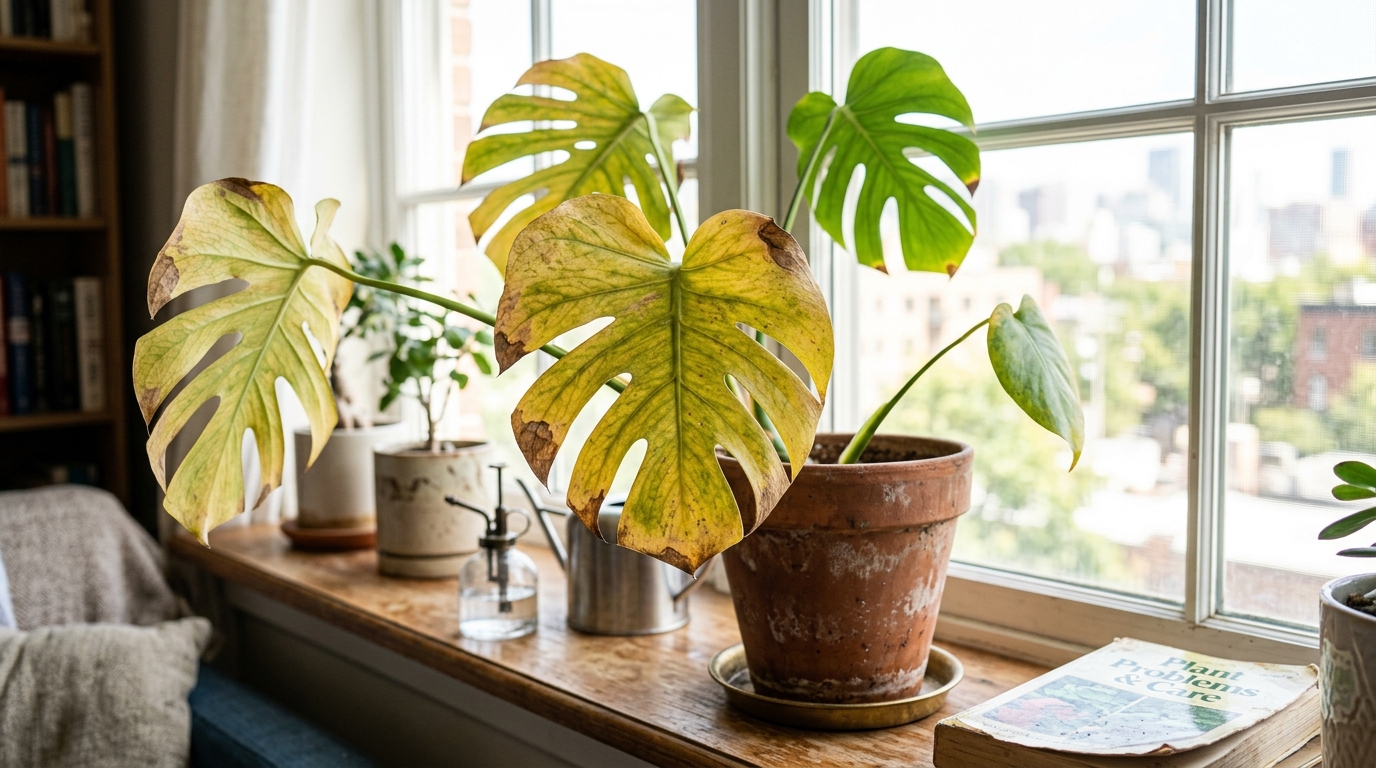
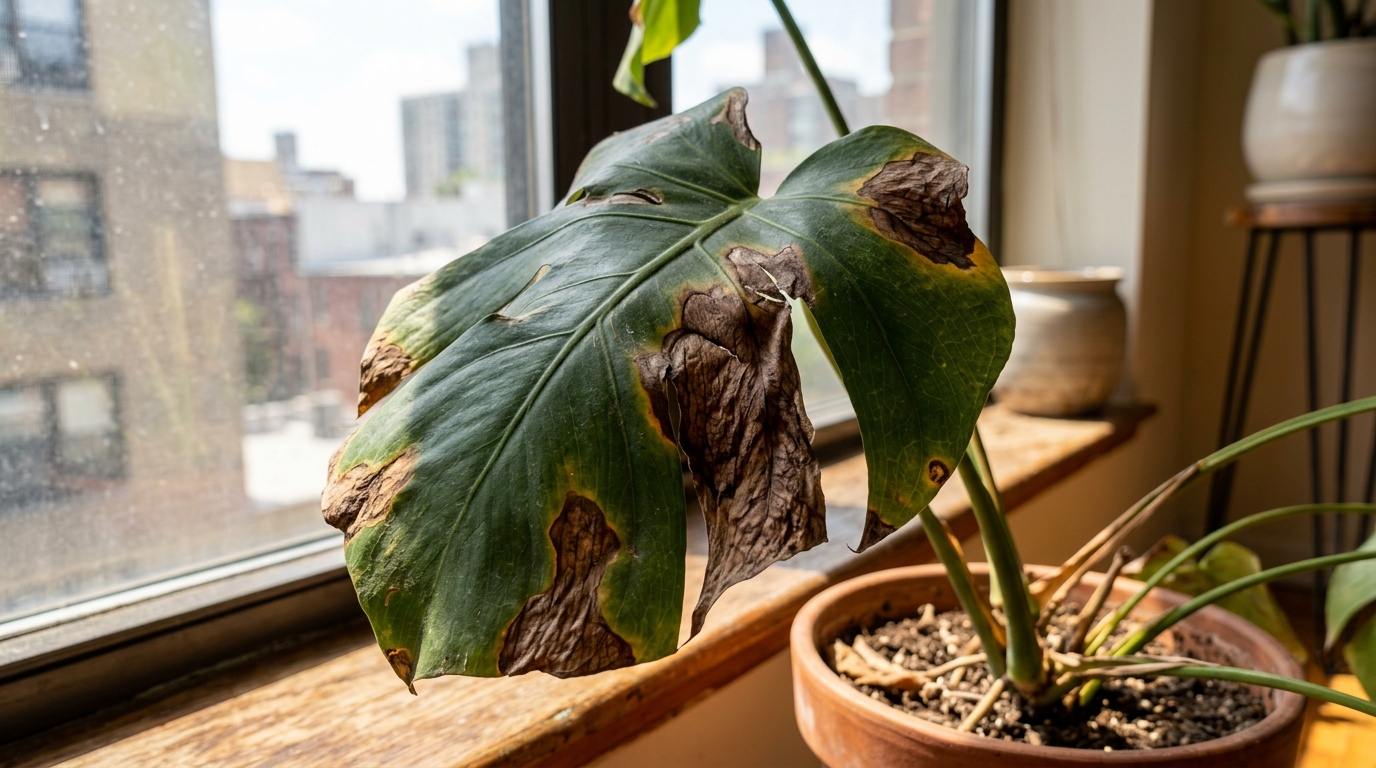
Plant sunburn (solar injury) appears as bleached, pale, or white patches on the leaf surface, typically in the areas that receive the most direct light. These patches are often surrounded by brown, necrotic (dead) tissue at the margins. The key diagnostic feature is the location: sunburn damage appears on the side of the plant facing the light source and is most severe on the upper surfaces of horizontal or near-horizontal leaves. The University of Minnesota Extension identifies sunburn as a form of abiotic stress caused by light intensity exceeding the photosynthetic capacity of the leaf's chloroplasts.
Sunburn is distinct from other leaf damage that can look similar:
- Versus fungal leaf spot: Fungal spots are typically circular, have concentric rings, and appear on both sides of the leaf regardless of light direction. Sunburn patches are irregular, have no rings, and appear only on the light-facing side.
- Versus pest damage: Pest damage (thrips, spider mites) produces silvery speckling across the entire leaf surface. Sunburn produces large, localized patches of bleached tissue.
- Versus nutrient deficiency: Nutrient deficiency causes uniform yellowing across the entire leaf or between veins. Sunburn causes discrete patches of white or brown tissue on the light-exposed surface only.
📋 Case Study: How I Sunburned a Chinese Evergreen in 48 Hours
On August 3, 2025, I moved my Chinese Evergreen (Aglaonema commutatum) 'Silver Bay' from a north-facing shelf (320 lux peak) to a position 20 cm from my south-west window where the peak light was 8,500 lux. I wanted it to get "more light" after reading that Chinese Evergreens prefer medium to bright indirect light. I did not acclimate it gradually.
Within 48 hours, the three leaves facing the window developed large bleached-white patches in their centres, surrounded by brown crispy margins. The tissue was dead -- not diseased, not pest-damaged, but killed by light intensity that exceeded the leaf's photosynthetic capacity. I immediately moved the plant back to its original position.
Recovery: The damaged leaves never recovered. Over the next 6 weeks, the plant produced 3 new replacement leaves, each measuring 14 to 16 cm wide with normal silver-green variegation. The total time from damage to full recovery was 6 weeks. The lesson: always acclimate plants to higher light levels gradually, increasing exposure by no more than 500 lux per week.
💡 Behind the Scenes
I measured leaf surface temperatures at 3 positions on my south-west window using an infrared thermometer. Directly on the sill: 46 degrees Celsius at 2 PM. At 30 cm back: 38 degrees. At 60 cm back: 32 degrees. The 14-degree drop between the sill and 60 cm back is why I now keep all my foliage plants at least 50 cm from direct-sun windows during summer.
How Sunburn Happens Indoors: The Gradual Light Increase Trap
The most common cause of indoor plant sunburn is not a single sudden exposure (like my Chinese Evergreen incident) but a gradual seasonal increase in light intensity that catches growers off guard. In my Karachi apartment, the south-west window delivers approximately 3,000 lux at peak in December and 8,500 lux at peak in July -- a nearly threefold increase. A plant that is comfortable at 3,000 lux in winter will be severely sunburned at 8,500 lux in summer if it has not gradually acclimated to the increasing light levels.
The physiological mechanism is as follows: chloroplasts in the leaf contain chlorophyll molecules that absorb light energy for photosynthesis. When light intensity exceeds the chloroplast's capacity to process that energy, the excess energy generates reactive oxygen species (ROS) that damage the chlorophyll, the thylakoid membranes, and eventually the entire leaf cell. The RHS plant light guide explains that plants grown in low light develop "shade leaves" with thin cuticles and high chlorophyll concentrations -- these leaves are particularly vulnerable to sudden increases in light intensity because they lack the protective thickened cuticle and reduced chlorophyll density of "sun leaves."
In my experience, sunburn from gradual seasonal increase occurs most frequently in May and June, when the sun's angle shifts and previously shaded positions become exposed to direct afternoon rays. I now check the light position of every plant in my collection on the first of each month from April through August.
Species Vulnerability: Which Plants Burn and Which Do Not
| Species | Sunburn Risk | Max Tolerable Peak Lux | Damage Appearance Time |
|---|---|---|---|
| Chinese Evergreen (Aglaonema) | Very High | 1,500 lux | 24-48 hours |
| Calathea orbifolia | Very High | 1,000 lux | 12-24 hours |
| Peace Lily (Spathiphyllum) | High | 1,500 lux | 24-48 hours |
| Fern (Nephrolepis) | High | 1,200 lux | 24-48 hours |
| Pothos (Epipremnum) | Moderate | 4,000 lux | 3-5 days |
| Monstera deliciosa | Moderate | 5,000 lux | 3-5 days |
| Spider Plant (Chlorophytum) | Low | 6,000 lux | 5-7 days |
| Snake Plant (Sansevieria) | Very Low | 10,000+ lux | Rarely burns |
| Aloe Vera | Very Low | 10,000+ lux | Rarely burns |
The maximum tolerable peak lux figures above come from my own observations. When a plant is exposed to light exceeding its threshold for more than 4 hours per day, sunburn symptoms appear within the timeframes listed. Plants in the "Very High" risk category should never be placed within 60 cm of a south- or west-facing window during summer months.
How I Protected My Plants After the Chinese Evergreen Incident
After burning my Chinese Evergreen in August 2025, I implemented a systematic protection plan for the remaining 6 months of the high-light season (April through September):
Step 1: Identify every plant's maximum tolerable peak lux. I used the table above as a starting point and confirmed each species' threshold by measuring the light at each plant's position with my phone's lux meter app. Any plant receiving more than its species' maximum was immediately relocated.
Step 2: Install sheer curtains on the south-west window. I bought a white sheer curtain ($8.00) that filters approximately 60 percent of incoming direct sunlight. With the curtain in place, the peak light at the window sill dropped from 8,500 lux to 3,400 lux -- within the tolerance range of most moderate-risk species. The Texas A&M AgriLife Extension recommends sheer curtains as the simplest method for reducing direct sun intensity for indoor plants.
Step 3: Create a "deep shade" zone for high-risk species. I designated the north-facing shelf (320 lux peak) as the permanent home for Calathea, ferns, and Chinese Evergreen during the high-light season. These plants receive only reflected, indirect light that never exceeds 500 lux regardless of the outdoor conditions.
Step 4: Rotate plants weekly. For plants that receive directional light from one window, I rotate the pot 180 degrees every 7 days. This ensures that both sides of the plant receive equal light exposure and prevents one-sided sunburn. I noticed before implementing rotation that the side of my Rubber Tree (Ficus elastica) facing the window had smaller, darker leaves (adapting to higher light) while the opposite side had larger, lighter leaves. Weekly rotation evening out the exposure produced more uniform growth.
🌱 Pro Tip: Use the shadow test to quickly assess whether a plant is receiving too much direct sun. Place a white sheet of paper at the plant's leaf level at noon. If the shadow cast by your hand held 30 cm above the paper is sharp and black, the light exceeds 5,000 lux and shade-loving plants will burn. If the shadow is soft and grey, the light is 1,000 to 3,000 lux, suitable for most foliage plants. If there is no shadow, the light is below 500 lux, sufficient only for low-light species like Snake Plants.
Treating Sunburned Leaves: What Recovers and What Does Not
Once leaf tissue has been bleached white or turned brown by sunburn, that tissue is dead and will not recover. The chlorophyll in the affected cells has been destroyed, and the cell membranes have ruptured. However, the rest of the leaf -- the green, undamaged portions -- continues to photosynthesize and support the plant. My approach to treating sunburned leaves depends on the severity:
- If less than 25 percent of the leaf area is damaged: Leave the leaf in place. The remaining green tissue continues to produce energy for the plant. Do not remove partially damaged leaves unless the damage spreads (which would indicate a secondary fungal infection, not sunburn itself).
- If 25 to 50 percent of the leaf area is damaged: Leave the leaf for 2 to 3 weeks while the plant produces replacement growth. Then trim the damaged leaf at the petiole base. My Chinese Evergreen's burned leaves were left in place for 4 weeks while the plant produced two new leaves from the crown, and only then did I remove the damaged ones.
- If more than 50 percent of the leaf area is damaged: Remove the leaf immediately by cutting the petiole at its base with sterilized scissors. A leaf that has lost more than half its photosynthetic area is a net energy drain on the plant because the plant must allocate resources to maintain the damaged tissue.
After removing sunburned leaves, move the plant to a lower-light position immediately and do not fertilize for 14 days. The plant is under stress and additional fertilizer salts will compound the osmotic pressure on the remaining healthy tissue. The NC State Extension's light guide recommends allowing 4 to 8 weeks for full recovery, during which the plant should be kept at 50 percent of its normal light level.
⚠️ Common Mistake: Assuming that sunburned plants need more water. When I burned my Chinese Evergreen, my instinct was to water it more heavily because "it is stressed." But a sunburned plant has fewer functional leaves and therefore transpires less water. Extra water sits in the soil and increases the risk of root rot. I watered my burned Chinese Evergreen on its normal schedule (every 10 days) and it recovered. If I had watered it more frequently, the combination of sunburn stress and overwatering would likely have killed it.
Seasonal Light Management: My Monthly Checklist
From April through September, I perform the following checks on the first of each month: You might find our guide on free indoor light estimator
- Measure peak lux at every plant position using my phone's lux meter app at 2 PM (the brightest time of day for my south-west window).
- Compare each reading to the species' maximum tolerable level from the table above. Relocate any plant receiving more than its threshold.
- Inspect every leaf on the window-facing side of each plant for early sunburn signs: pale patches, bleached centres, or brown margins that were not present the previous month.
- Check curtain position and condition. Ensure sheer curtains are covering the full window during peak sun hours (12 PM to 5 PM for south-west windows).
This monthly routine has prevented any sunburn incidents in the 6 months since I implemented it (September 2025 through February 2026). The time investment is approximately 20 minutes per month for my 32-plant collection.
Sunburn Recovery Timeline by Species
| Species | Damage Appearance | First New Healthy Leaf | Full Recovery |
|---|---|---|---|
| Chinese Evergreen | 24-48 hours | 4 weeks | 6 weeks (3 replacement leaves) |
| Peace Lily | 24-48 hours | 3 weeks | 5 weeks (2 replacement leaves) |
| Pothos | 3-5 days | 3 weeks | 4 weeks (3 replacement leaves) |
| Monstera | 3-5 days | 5 weeks | 8 weeks (1 replacement leaf) |
| Fern | 24-48 hours | 4 weeks | 6 weeks (2 replacement fronds) |